Why Your Marketing ROI is Low (and How To Fix It)

Are you wondering why your marketing spend feels more expensive than ever, whilst delivering fewer results?
You’re not imagining it. After working with hundreds of businesses generating £5-50m turnover, we’ve identified the exact disconnects causing marketing ROI to flatline — and more importantly, the specific shifts that will reverse this trend.
The uncomfortable truth Charlie Marchant (our CEO) and I, Dale Davies, discussed in this week’s podcast is that most marketing teams are measuring the wrong metrics, targeting the wrong audiences, or clinging to channels that stopped working months ago. But here’s what we discovered: fixing these issues doesn’t require a complete overhaul. It requires strategic adjustments that compound into transformative results.
Executive Summary
Your marketing ROI is likely suffering because of five critical failures that compound silently until they become impossible to ignore.
The primary culprits we identified:
- Misalignment between marketing metrics and business goals
- Targeting everyone instead of someone specific
- Channel mix that ignores where your customers actually spend time
- Risk aversion that prevents necessary experimentation
- Ignoring the AI search revolution reshaping customer journeys
As Charlie explained during our conversation: “If your bottom line goal is generating a certain number of leads or making a certain amount of revenue, then understanding which marketing channels are actually driving those leads or driving that revenue — and which percentage of your marketing budget is experimental — that’s where most businesses fall down.”
This guide reveals exactly how to identify which failure points are undermining your marketing performance and provides the actionable framework we use with our clients to fix them.
Why Marketing Teams Struggle to Connect Spend to Revenue
The disconnect between marketing activity and revenue isn’t a tracking problem — it’s a fundamental misalignment of priorities that Charlie and I see constantly.
Marketing teams track Share of Voice, organic rankings, and social followers. Meanwhile, the board wants to know about closed deals, total contract values, and recurring revenue. This language barrier creates a dangerous blind spot where marketing celebrates vanity metrics whilst revenue stagnates.
Charlie highlighted three specific reasons this disconnect persists:
1. Marketing pursues different goals than the business
Marketing departments often focus on progress markers — rankings, followers, impressions — rather than bottom-line impact. These aren’t wrong metrics, but they’re incomplete without the connection to revenue.
2. The lead-to-revenue feedback loop breaks down
“In businesses generating leads, there’s a potential disconnect because marketing brings in the leads, but sales closes them into revenue,” Charlie explained. Without a strong feedback mechanism, marketing optimises for quantity whilst sales struggles with quality.
3. Reporting speaks different languages to different stakeholders
Your CMO thinks in CPL and MQLs. Your CEO thinks in ARR and LTV. When these metrics don’t translate clearly, investment decisions get made on incomplete information.
The solution isn’t choosing one set of metrics over another — it’s creating a clear cascade from business goals to marketing KPIs. As Charlie puts it, you need to understand “which percentage of your marketing budget is experimental or very brand awareness, top of funnel stuff that you don’t expect to be able to directly attribute.”
We recommend an 80/20 split: 80% on measurable, repeatable activities that generate leads or revenue, and 20% on experimentation and brand-building that’s harder to measure but essential for growth.
When Your Targeting Misses the Mark
Here’s the trap that killed Finisterre’s growth (before they fixed it): trying to be everything to everyone.
Charlie shared a fascinating case study during our discussion. Finisterre, the outdoor apparel company focused on cold-water surfing, brought in a new head of marketing from a high-street brand. Her strategy? Go broader to capture more market share.
“They’d become really generic, really boring, and they didn’t have any kind of USP,” Charlie explained. “They were no longer focused on that specific niche of cold water surf.”
The result? Sales declined.
They’d lost what made them distinctive — targeting cold-water surfers specifically — and became just another outdoor brand competing with hundreds of others. They reversed course, returned to their niche positioning, and recovered their growth.
The everything-for-everyone trap manifests in three ways:
Audience dilution: Your messaging becomes so broad that nobody feels it’s specifically for them. You’re speaking to everyone and connecting with no one.
Product confusion: You offer so many options that decision paralysis sets in. Customers can’t identify what they actually need from you.
Positioning paralysis: You become afraid to exclude anyone, so you never commit to serving someone exceptionally well.
The counterintuitive truth? Narrowing your focus expands your growth potential. Look at Vita Coco — they dominated coconut water before expanding into flavoured variants and coconut-based beauty products. But that expansion came after achieving market leadership in their core category, not before.
As I mentioned in the podcast, expanding your positioning requires significant investment: “To grow your share of market, you need to overspend what all of your competitors are doing to reduce their effectiveness.”
Without that investment? Stay focused. Own your niche completely before considering expansion.
How Channel Mix Impacts Your Bottom Line
Your channel mix might be the silent killer of your marketing ROI — especially if you’re still using last year’s strategy for this year’s customers.
“Understanding how many leads or how much bottom line revenue each marketing channel brings can be really difficult,” Charlie noted, “because quite often we’re using last click attribution.”
Think about your last significant purchase. You probably saw the brand on social media, clicked a Google ad, read reviews, asked ChatGPT for alternatives, then finally purchased through an email. Which channel gets the credit? In most systems, email wins — but that completely misses the journey.
The two extremes that destroy ROI:
1. Spreading too thin across every channel
Charlie compared this to betting £1 on every horse in a race: “You’ve lost money because the winnings for the one horse where you only had a pound on it, but you spent nine other pounds as well.”
Testing everything simultaneously means you can’t properly evaluate anything. You need sufficient budget in each channel to achieve statistical significance and optimise effectively.
2. Never experimenting with new channels
The opposite problem is equally dangerous. “If you are not thinking about that little bit of experimentation,” Charlie warned, “you are gonna find that you fall behind.”
Channels decay. What worked brilliantly two years ago might be saturated now. Without controlled experiments, you won’t discover the next growth driver until it’s too late.
The strategic approach we recommend:
- Audit your current attribution to understand the full customer journey
- Identify your top 3 performing channels and double down
- Allocate 20% of budget to test one new channel properly
- Use self-attribution (simply asking customers) to validate your data
In our own marketing, we use HubSpot to track both technical attribution and self-reported attribution. Often, tracking shows “organic” but customers tell us “YouTube” — revealing the true journey from discovery to conversion.
What Happens When You Stop Experimenting
Risk aversion is slowly strangling your marketing growth — and you might not notice until it’s too late.
“The experimenting with nothing and therefore achieving nothing because you have become so risk averse,” as Charlie described it, creates a particularly insidious problem. Your metrics decline gradually, making it easy to blame market conditions rather than strategic stagnation.
Here’s what strategic experimentation actually looks like:
Immediate tests (this month):
- New ad creative formats
- Different email send times
- Alternative landing page layouts
Channel experiments (this quarter):
- Testing podcast advertising if you’re B2B
- Exploring TikTok if you’re targeting Gen Z
- Investigating LinkedIn newsletters for thought leadership
Strategic pivots (this year):
- Exploring AI Search Optimisation
- Building community platforms
- Developing video content strategies
Charlie’s framework is elegantly simple: “80% of the marketing budget on tangible marketing activities that are perfectly repeatable… and then you’ve got a 20% budget on stuff that’s a little bit more intangible.”
That 20% isn’t random testing — it’s calculated risk-taking based on where your customers are moving. As Charlie pointed out, if you’re still only thinking about Google whilst your customers are asking ChatGPT for recommendations, you’re already behind.
The businesses that will dominate aren’t those avoiding all risk — they’re those taking intelligent, measured risks whilst maintaining stable revenue generation.
Where AI Search Changes Everything
The marketing landscape is fracturing, and businesses fixated solely on Google are missing the revolution happening in plain sight.
“The majority of businesses are still thinking about Google and Google search,” Charlie observed, “and if you are not thinking about that little bit of experimentation… you are gonna find that you fall behind.”
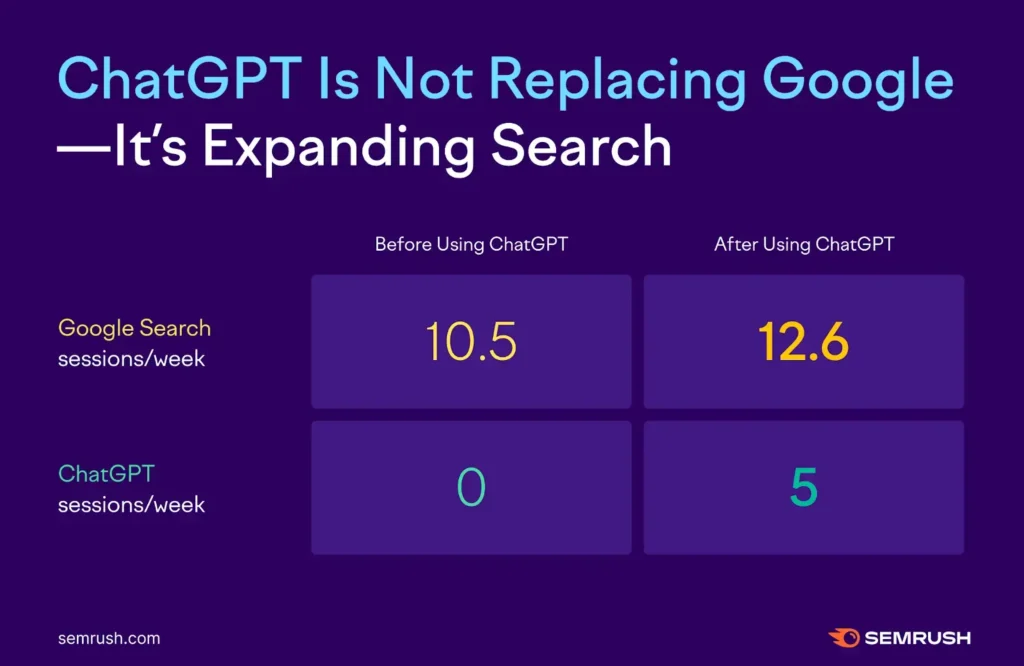
But here’s the plot twist I shared from recent Semrush research: Google searches are actually increasing for power users — from 10 to 13 searches daily. These same users are consulting ChatGPT and Claude multiple times before heading to Google for final validation.
The new customer journey looks like this:
- Initial research on ChatGPT (3–5 queries)
- Validation on Google (1–2 searches)
- Zero-click answers or direct brand visits
- Purchase decision
Your organic traffic might be declining not because fewer people are searching, but because the funnel has condensed. Users arrive more informed, more decisive, and more likely to convert — if you’re visible across their entire journey.
New metrics for AI search success:
- Visibility in prompts: How often your brand appears in AI responses
- Sentiment scores: Whether AI mentions you positively or negatively
- Share of voice: Your percentage of mentions versus competitors
- Ranking position: Whether you’re mentioned first, second, or third
“It’s absolutely fascinating,” I mentioned in the podcast, watching how these platforms “mention price as a blocker within the LLM before you even get to that final search on Google.”
The businesses winning this transition aren’t abandoning SEO — they’re expanding their definition of search visibility to include every platform where customers seek recommendations.
Next Steps
Your marketing ROI won’t improve through incremental tweaks. It requires decisive action on the disconnects we’ve identified.
This week:
- Map your current attribution from first touch to conversion
- Survey your last 20 customers about how they discovered you
- Identify which 20% of your budget could shift to experimentation
Next 30 days:
- Implement proper multi-touch attribution tracking
- Choose one new channel for controlled testing
- Set up AI search visibility monitoring for your brand
Next 90 days:
- Complete a full channel audit with ROI by source
- Develop positioning for your most profitable customer segment
- Build your 2025 strategy with 80/20 budget allocation
As Charlie emphasised: “Sometimes getting a second opinion on it can be really helpful. Gives you new ideas, a fresh perspective on what you’re doing.”
That’s exactly what our free marketing review provides — an objective analysis of your current performance with specific recommendations for improvement.
Resources Mentioned
In Conclusion
Your marketing ROI is low because you’re optimising for yesterday’s customer journey whilst tomorrow’s buyers are already somewhere else.
The fix isn’t complicated, but it requires courage. Courage to narrow your targeting when everyone says go broader. Courage to cut underperforming channels you’ve always used. Courage to experiment when the board wants predictability.
As Charlie concluded: “You need to have that little bit of risky edge to be experimenting with something, whilst being sensible enough to keep something else running consistently.”
The businesses that master this balance — strategic stability with calculated innovation — will capture disproportionate market share whilst others wonder why their marketing stopped working.
Your next move should align with where your customers are heading, not where they’ve been. The question isn’t whether to evolve your marketing strategy. It’s whether you’ll lead that evolution or chase it.
Watch This Next
Dedicating your marketing budget to experimenting with, or going all-in on, AI Search will be essential in 2026.
If you’re not clear on how AI Search works, or you’d like to know more about the metrics to track or how to optimise your content, then check out our other recent videos, podcasts, and blogs to learn more: