Law Firm PPC 2026: How to Run Google Ads That Generate Qualified Client Enquiries

PPC is a great marketing channel for any law firm. It allows you to connect directly with potential clients.
A few practices you should follow to create fantastic law firm PPC ads include:
- Engaging copy that gives the viewer a reason to click
- Add an eye-catching headline
- Use great visuals (in ads that use visuals)
- Adapt your ads for different audiences and searches
- A/B test your ads to see what resonates with your audience
- Monitor analytics like click-through rate (CTR), conversion rate, engagement and return on ad spend (ROI)
- Adjust ad creative (that’s your copy and visuals) if you see a performance dip.
Download our free guide, which includes a PPC checklist to ensure your ads are well-optimised.
What Is Law Firm PPC and How Does It Work?
Pay-per-click advertising, more commonly known as PPC, refers to all online advertising, not just the ones where you pay for each click.
PPC ad campaigns include Google search ads, YouTube ads, banner ads and social media ads.
There are more types of PPC ads, but these are the ones you’ll use most in your law firm’s PPC campaigns.
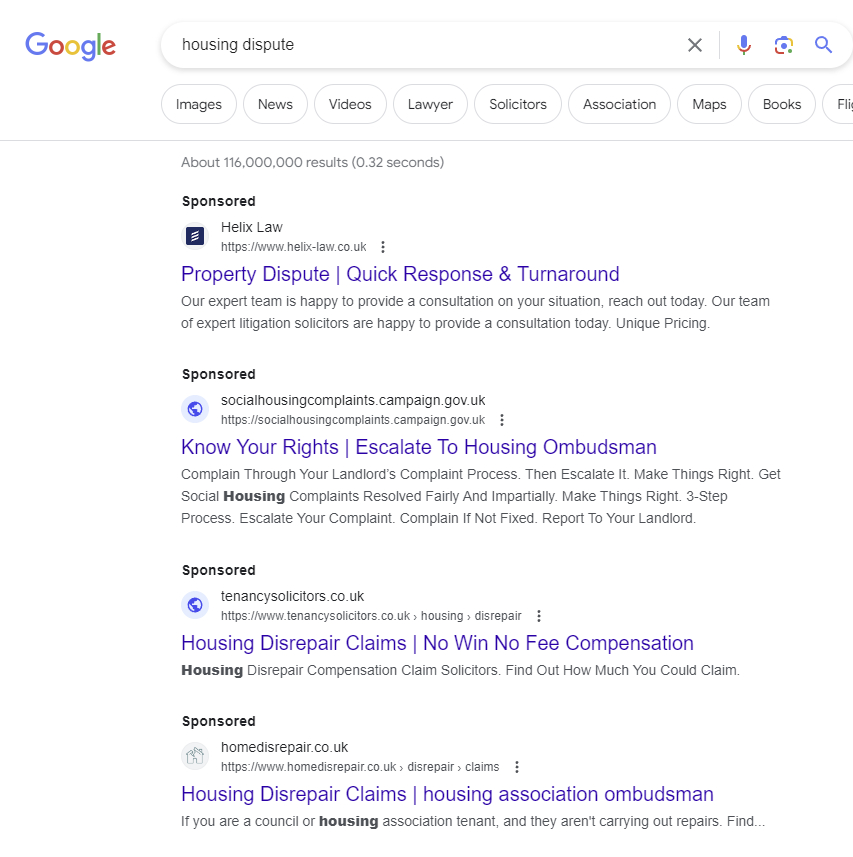
Google search ads appear at the top and bottom of the search engine results pages (SERPs). The placement isn’t just based on spend. Google also takes into account the quality of your ads.
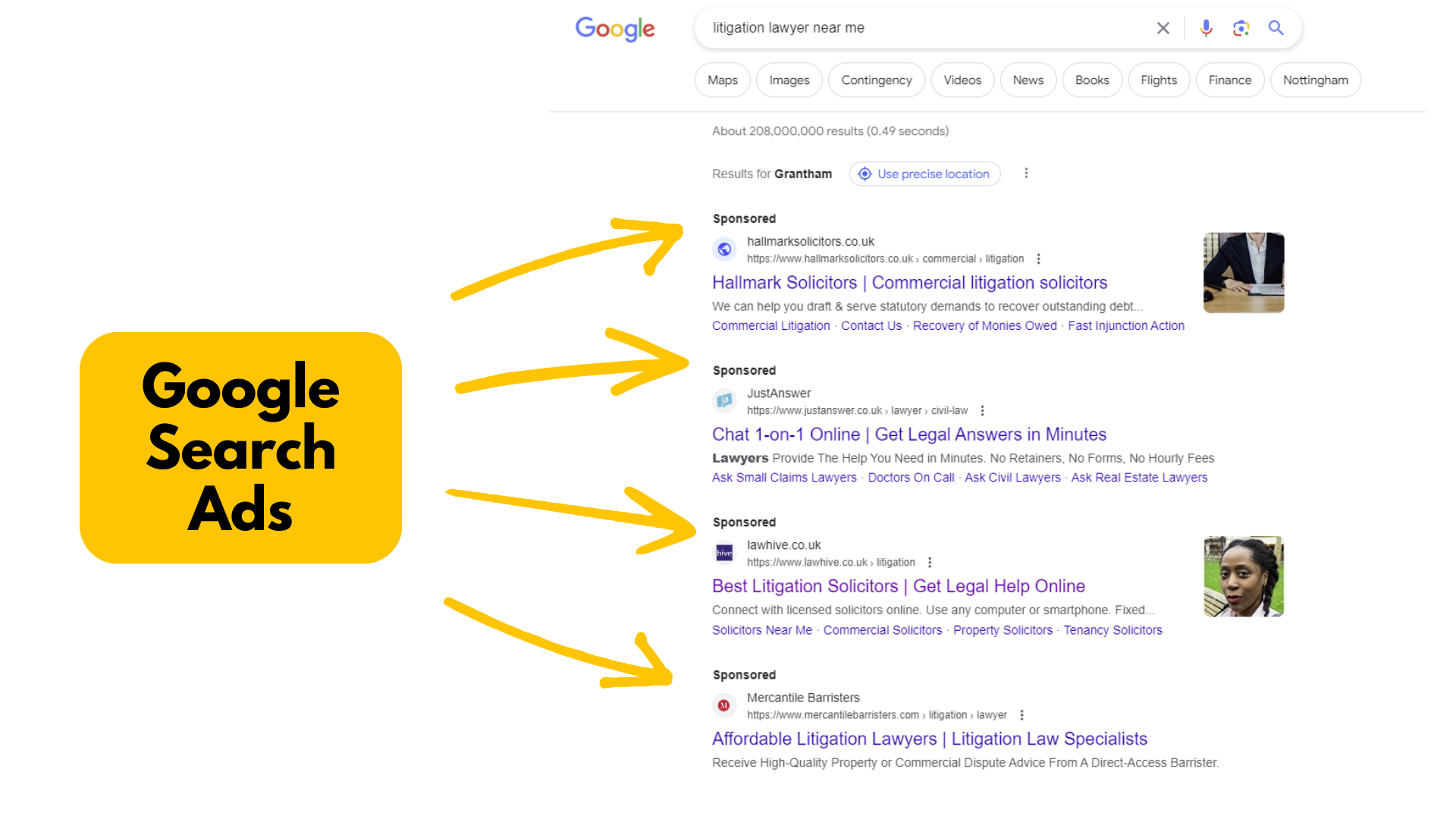
In Google’s AI Search Generative Experience, SGE, ads will be included in and around the AI-generated answer.
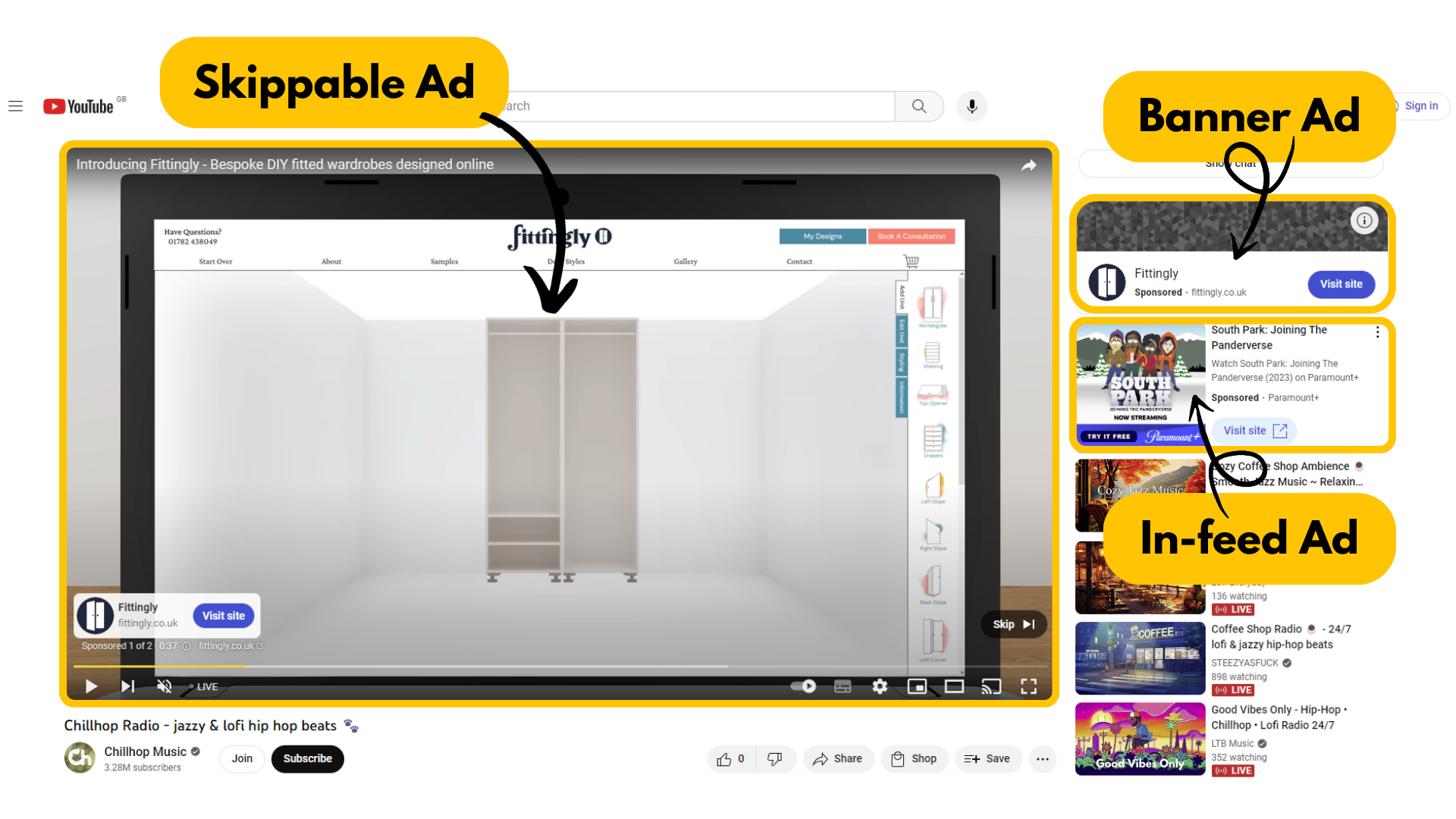
YouTube ads appear in a few different places. Video ads can run at the start, middle or end of YouTube videos. The user can skip some of these ads, and you only pay if they watch 30 seconds or more of your ad. Other YouTube ads are unskippable; users must watch them to get to their main content.
Banner ads also appear on YouTube next to some videos. In-feed ads are another option. They appear among the other search results.
Banner ads run on websites around the internet. These are often run through Google ads, too. The image below shows three different banner ads on the Lawyer Monthly website.

Social media ads run in different formats depending on the platform you use.
It’s best to use social media ads to retarget people who have visited your site in the past. It’s unlikely people will make an impulse purchase with a law firm, which is what many social media ads are designed to do.
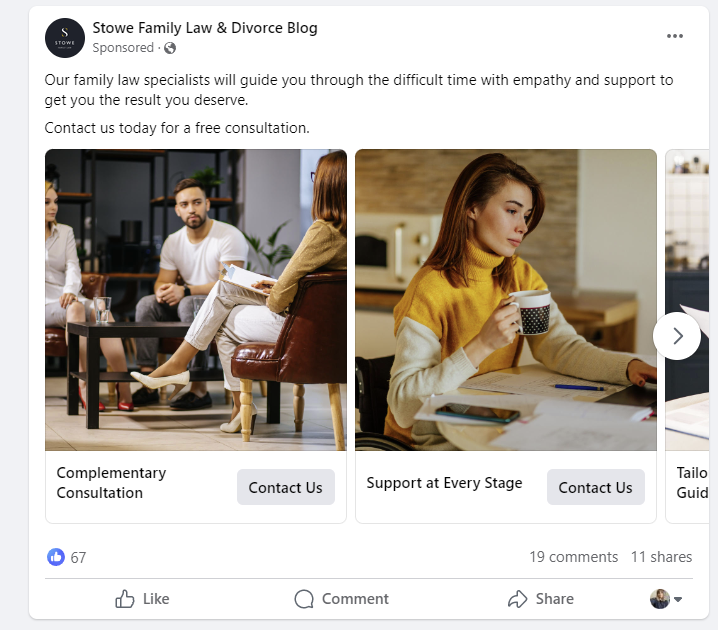
Retargeting past visitors on social media reminds them of your USPs and why they should hire you, which is useful if they shop around.
Using a mix of these different types of ads would be the best PPC strategy for your law firm, but we suggest prioritising Google search ads to start with.
Common Law Firm PPC Terms You Need to Know
PPC campaigns are full of jargon. Here are some of the most common PPC terms and how they relate to your ads.
Click-through-rate (CTR)
CTR is the ratio of users who click on an ad to the number of times the ad is shown.
For example, if an ad is displayed 100 times and is clicked on 5 times, the CTR is 5%.
Cost-per-click (CPC)
CPC is the amount you pay each time someone clicks on your ad.
For example, if you pay $1 each time your ad is clicked and the ad is clicked 100 times, the spend is $100, and the CPC is $1.
Cost-per-impression (CPI)
CPI is the amount you pay for every 1,000 impressions (views) of your ad.
For example, if an ad campaign costs a total of $20 and receives 10,000 impressions, the CPI is $2 ($20/10,000 impressions).
Conversion Rate (CR)
CR can be measured in a few different ways. It can be the percentage of website visitors from your ads who complete a desired action. It could also be the number of people who just click your ads. It depends on what you’re counting as a conversion.
For example, if 100 people visit your website and 1 becomes a client, the conversion rate is 1% (1 client/100 visitors). We increased the PPC conversion rate for a client by 207%.
Cost-per-acquisition (CPA)
CPA is the cost of acquiring a new customer.
For example, if an ad campaign spends $1,000 and acquires 100 new customers, the CPA is $10 ($1,000 total cost/100 new customers).
Call-to-action (CTA)
The CTA is the text or graphics in your ad that’s meant to prompt a desired response from the viewer.
For example, “Get a free consultation” or “Find out if you have a case”.
Why Should Law Firms Use PPC Ads?
There are a few reasons why PPC ad campaigns are important for law firms. Not only do they help you reach your ideal customer faster, but they can also help you compete with AI.
Law firm PPC is often expensive because of high competition, but the benefits are huge.
And, if you create strong PPC ads, you’ll get a good return on investment (ROI).
5 Benefits of PPC Advertising for Law Firms
Targeted reach
PPC allows you to target your ads precisely to your ideal clients based on location, demographics, keywords, interests, and more.
This helps you connect with clients actively searching for legal services with a message and CTA that resonates with them.
Measurable results
With PPC, you only pay when someone clicks your ad. This makes tracking and optimising your ad spend easy based on metrics like cost-per-click and conversion rate.
Flexibility
PPC campaigns can be adjusted quickly based on performance. You can change targeting, bids, ad copy, landing pages, and more to improve results.
Competitive edge
Good PPC puts your law firm’s ad in front of people right when they are searching for legal help.
This allows you to stand out from competitors in online search results — especially when there are so many poor ads out there.
Cost-effective
PPC costs are only incurred when someone clicks your ad. This is often a more affordable way to reach potential clients than traditional advertising. It’s easy to turn PPC up or down, depending on your goals and budget.
Legal keywords are some of the most expensive in Google Ads. The average cost per click across attorneys and legal services is £8.58, but this varies hugely by practice area:
- Personal injury: £15–50+ per click (extreme competition, but high case values justify the spend)
- Medical negligence: £30–100+ per click (viable mainly for established firms)
- Family law: £3.44–£13.96 per click
- Conveyancing: around £8 per click
The average cost per lead across legal PPC is £131.63, roughly 15 times the average CPC, because the typical legal PPC conversion rate is only 5.09%. That means a firm targeting 15 enquiries a month needs around 300 clicks. Click fraud is also a material risk in this sector, with fraud rates reaching 13–25% of ad spend in competitive practice areas, so monitoring for unusual traffic is essential.
It’s also worth understanding Google’s Local Services Ads (LSAs, shown with a “Google Screened” badge), which sit above traditional search ads and run on a pay-per-lead rather than pay-per-click model. For many UK law firms, LSAs generate qualified leads at a lower cost than standard Google Ads.
How to Create a Successful Law Firm PPC Campaign: Step-by-Step
Every successful PPC campaign needs a solid plan and strategy behind it.
1. Keyword Research for Law Firm PPC: High-Intent Legal Keywords
Review your SEO keywords and identify the keywords you want to target with PPC.
- Have you seen a drop in traffic from a keyword you rank in position 1 for? Check the search engine results page (SERP) to see if competitors run ads there. You will want to run competing ads.
- Are there some keywords you want traffic for but are struggling to rank? Perhaps you’ve added a new service and want a traffic boost while your page steps up the ranking. PPC is a great fit for this.
- Use a tool like Semrush (which you can try for free for 14 days with our link), to identify new keywords that could be a good fit for your law firm’s PPC ads.
2. Competitor Research: What Are Rival Firms Bidding On?
While researching your keywords, analyse competitor ads to find out what works.
- Pay attention to the language and CTAs competitors use.
- See if they use ad extensions
- Take inspiration from the ad imagery.
3. Ad Creative: Writing Compliant, High-Converting Legal Ad Copy
When creating a search ad, it’s essential to include the following:
- A strong headline that’s enticing and contains the keywords you are targeting. Think back to the titles of the blogs we discussed earlier.
- A compelling offering in the text. This should clarify your offering and why the viewer should choose you.
- Ad extensions, including other relevant pages on your site or a click-to-call button so viewers can get in touch right away. Consider the intent of the search. Ads run on a search where users are not quite ready to convert will have different CTAs to those that are for people ready to get in touch with your law firm.
One more thing to check before any ad goes live: in the UK, all law firm PPC ad copy must comply with SRA advertising rules and the ASA codes. This means no misleading claims about outcomes, accurate fee information (particularly for no-win-no-fee arrangements), genuine testimonials with documented consent, and no sensationalist language that creates unrealistic expectations. Compliant ad copy that still compels action is one of the most specialised skills in legal PPC management.
When creating a social media ad, it’s important to include:
- A scroll-stopping image that grabs the viewer’s attention
- A compelling offering in the text. This should clarify your offering and why the viewer should choose you.
- A compelling, relevant CTA.
If you decide to go the video ad route, you need to include:
- High-quality, scroll-stopping video that grabs the viewer’s attention
- A script that gets straight to the point, with a hook that keeps the viewer watching
- A strong, relevant CTA.

4. Landing Pages: Why Your Post-Click Experience Determines ROI
Landing pages are the pages visitors land on when they click on your ads and are key to a PPC campaign’s success.
If you have a great ad for your family law services, but the link in the ad takes users to your homepage, they’ll be unlikely to convert.
Your landing pages should be relevant, easy to navigate and have a strong CTA.
How to Measure Your Law Firm’s PPC Campaign Performance
Monitor your PPC ad’s stats to ensure they get the desired result.
Don’t fall into the trap of thinking that lots of views mean your ad is good. If no one clicks or converts, it’s a waste of money.
You need to track:
- Click-through-rate (CTR)
- Cost-per-click (CPC)
- Return on investment (ROI)
If any of these stats drop, it’s likely you need to refresh your ads. You could change the imagery, test a new CTA or highlight a different USP.
PPC Strategies for Lawyers and Law Firms
Now, you have everything you need to run a great PPC campaign for your law firm.
Remember:
- Start with keyword research
- Identify what’s working (and what isn’t working) for competitors
- Create strong ads using text, visuals and relevant CTAs
- Send visitors to well-designed landing pages
- Measure your campaign’s results
- Adjust your campaign if needed.
- Learn more about marketing your law firm in our downloadable guide.
Beyond the campaign basics above, here are six strategies that make the biggest difference to law firm PPC performance:
- Build a negative keyword list from day one. Exclude educational and DIY searches like “free legal advice” or “DIY divorce”, these clicks cost money without ever converting into paying clients.
- Use geographic targeting for local firms. If you only serve clients in specific towns or counties, restrict your campaigns to those areas rather than paying for clicks you can’t act on.
- Separate campaigns by practice area. Combining, say, employment law and personal injury keywords in one campaign lets Google concentrate spend on whichever keywords convert cheapest, which often means your lower-margin work crowds out your higher-margin specialist services. Run separate campaigns with their own budgets instead.
- Weigh up Local Services Ads against traditional Google Ads. LSAs run on a pay-per-lead model and can produce better-qualified leads at a lower cost than standard search ads, but they come with their own verification process and data-handling considerations. Decide which model fits your firm before committing budget to either.
- Match your landing page to your ad, precisely. A visitor who clicks a personal injury ad and lands on your general homepage is unlikely to convert. Build a dedicated landing page for each practice area your ads target.
- Track conversions beyond the click. Set up offline conversion tracking so you can see which clicks actually turned into signed cases, not just form submissions or calls. This is the only way to calculate your true cost per client, rather than just cost per lead.
How much does law firm PPC cost in the UK?
The average cost per click for legal keywords is £8.58, but this varies by practice area, from around £8 for conveyancing up to £15–50+ for personal injury. The average cost per lead across legal PPC is £131.63.
What’s the difference between Google Ads and Google Local Services Ads?
Traditional Google Ads charge per click and appear in standard search results. Local Services Ads (LSAs) appear above them with a “Google Screened” badge, charge per lead rather than per click, and require identity verification through Google.
How do I make sure my law firm’s PPC ads comply with SRA rules?
Avoid misleading claims about outcomes, state fees accurately (especially for no-win-no-fee arrangements), only use testimonials with documented consent, and avoid sensationalist or urgency-driven language. Check your ad copy against the SRA Code of Conduct and ASA rules before it goes live.
How quickly can PPC generate leads for a law firm?
PPC can generate clicks and enquiries from the day a campaign goes live, but most campaigns need several weeks of data before you can judge performance properly and start optimising with confidence.
Should a law firm use PPC or SEO?
Both, ideally. PPC gives you immediate visibility while SEO builds towards a lower cost per lead over time. Many firms use PPC to generate leads quickly while their organic rankings are still developing.
What to Read Next
- How to Rank Your Law Firm at the Top of Google
- Earn 10x More Legal Clients
- 5 Powerful Lead Generation Strategies for 2024