
Sephora’s HUGE $7 Billion Search Mistake

Cosmetics retail giant Sephora stands tall as one of LVMH’s crown jewels — a multi-billion dollar e-commerce success story still growing at double digits annually. With plans to open 20 new UK stores by 2026, their expansion shows no signs of slowing.
On the surface, Sephora’s digital marketing looks flawless. They’re attracting 18 million organic visits monthly from Google alone. They command massive social media followings, invest approximately $34 million yearly in paid advertising (across display, video, and social), orchestrate extensive influencer campaigns through their Sephora Squad program, and maintain strategic partnerships that would make any marketer envious.
All of this has culminated in a brand that Interbrand values at a staggering $7.2 billion.
Yet beneath this polished exterior lies a critical vulnerability that could threaten Sephora’s digital dominance: they’re practically invisible in AI search.
Executive Summary
This analysis examines Sephora’s marketing strategy, revealing a stark contrast between its traditional search dominance and its AI search invisibility.
Key findings include:
- Sephora commands an impressive organic search presence with 17.7 million monthly visits and 10.5 million backlinks from 118,000 domains
- Their website’s authority score of 84 positions them as an industry powerhouse in traditional search
- Despite dominating in branded searches (77% of their traffic), product category searches, and brand-specific searches, Sephora is severely underperforming in AI search results
- Their content strategy lacks the informational depth that AI search tools prioritise, with minimal educational content and thin product descriptions
- As AI search adoption grows (with 39% of consumers already using it for online shopping according to Adobe), Sephora risks losing significant visibility to competitors with stronger informational content
This disconnect represents both a warning for established brands and an opportunity for challengers to gain ground in the rapidly evolving search landscape.
Sephora’s Traditional Search Dominance: A Masterclass in SEO
When it comes to conventional search visibility, few retail brands can match Sephora’s commanding presence. Their performance metrics tell the story of a digital juggernaut:
- Massive organic traffic: 17.7 million monthly organic search visits worldwide
- Exceptional domain authority: An impressive authority score of 84
- Robust backlink profile: 10.5 million backlinks from 118,000 referring domains
- Consistent growth: UK traffic up 4% month-on-month, German traffic increasing by nearly 11%
This dominance extends across three critical keyword categories:
1. Brand Searches
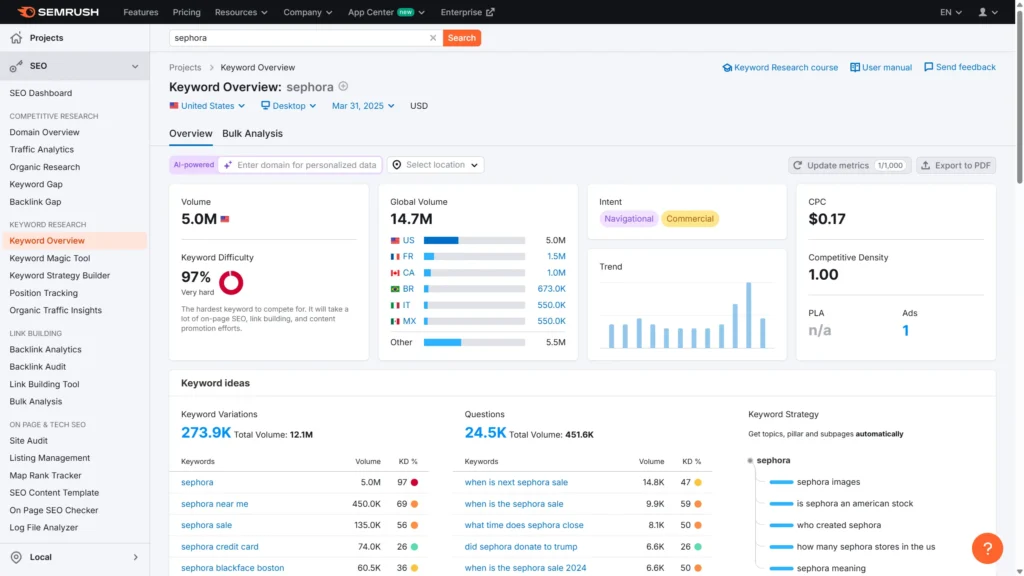
Sephora’s brand recognition drives enormous traffic, with approximately 4 million monthly visits from the keyword “Sephora” alone.
In total, branded search terms account for 77% of their organic traffic — a testament to their marketing effectiveness across channels.
This level of brand dominance creates a powerful competitive advantage. When consumers search specifically for “Sephora” rather than generic terms like “beauty retailer,” they’ve already decided where to shop before even reaching Google. It’s the digital equivalent of consumers asking for a “Kleenex” rather than a “tissue” — the brand has become synonymous with the category itself.
2. Product Category Searches
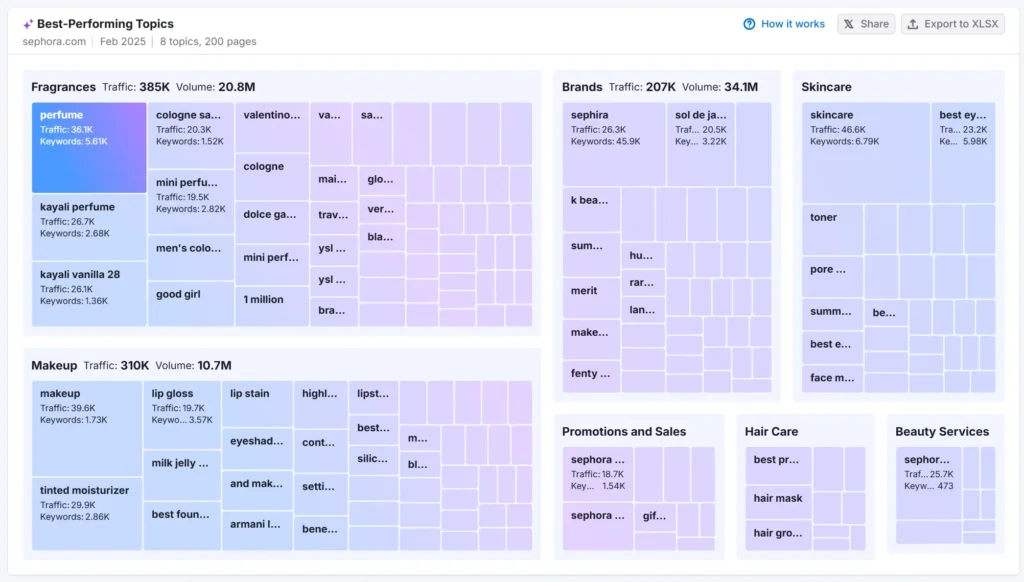
Even in fiercely competitive categories, Sephora maintains top positions. They consistently rank in positions 1-2 for high-value terms like:
- “perfume” and its variations
- “skin care” and related phrases
- “moisturizer” and similar product categories
Ranking for these broad category terms represents one of the most challenging achievements in eCommerce SEO. These “trophy keywords” typically drive hundreds of thousands of monthly searches and feature intense competition from both dedicated retailers and department stores. Sephora’s ability to capture these terms, despite relatively thin content, speaks to the strength of its technical SEO and link authority.
3. Brand and Product Searches
For the products and brands they carry, Sephora often claims the top position.
For example, searches for “Kayali Vanilla” and its variations consistently lead to Sephora’s product pages — effectively capturing traffic that might otherwise go directly to the manufacturer.
This creates a powerful competitive moat. Even when consumers search specifically for a brand like Fenty Beauty or Drunk Elephant, Sephora often intercepts that traffic before it reaches the brand’s own website — allowing them to maintain their position as the primary distribution channel even as direct-to-consumer models become increasingly popular.
The Foundation of Sephora’s Search Success
Sephora’s traditional search dominance rests primarily on two pillars:
Elite-Level Link Building
Their backlink profile reads like a who’s who of high-authority publications:
- Major publications: New York Times, Glamour, Vanity Fair
- Industry-specific authorities: Pop Sugar, Bustle, Grazia, Vogue, Elite Daily
This extensive network of high-quality backlinks provides the authority signals that Google traditionally values, allowing Sephora to rank well despite their second pillar — or rather, their surprising weakness.
What sets Sephora’s backlink profile apart is the quality of these mentions. Unlike many retailers who accumulate primarily transactional links, Sephora has secured editorial mentions where beauty editors reference them not just as a retailer but as an authoritative source on beauty trends. This editorial endorsement carries significantly more weight in Google’s algorithm than purely commercial relationships.
Minimal On-Page Content
Surprisingly, Sephora achieves its search dominance with remarkably thin on-site content:
- Their homepage contains almost no descriptive text content
- Product category pages feature minimal copy
- Brand pages lack substantial information about the brands they carry
- What little text exists often feels templated rather than genuinely informative
This approach has worked well in the traditional search paradigm, where backlinks and technical SEO could compensate for content limitations. However, it creates a significant vulnerability in the emerging AI search landscape.
Sephora’s minimalist content strategy likely stems from a focus on conversion optimisation — keeping pages clean, visually focused, and free from elements that might distract from the purchase journey. While this approach has proven effective for driving transactions in traditional search, it fundamentally misaligns with how AI search tools evaluate expertise and authority.
The AI Search Threat: Sephora’s $7 Billion Blindspot
As AI-powered search tools rapidly gain adoption, Sephora faces a serious visibility crisis. Adobe research reveals the scale of this shift:
- AI search referrals increased by 1,300% during the most recent holiday season
- 39% of respondents now use AI search for online shopping
- 47% rely on AI for product recommendations
Yet in this expanding channel, Sephora is notably absent.
The implications of these statistics are significant. We’re witnessing the early stages of a fundamental shift in how consumers discover products — comparable to the transition from print to digital advertising or from desktop to mobile search. The 1,300% year-over-year growth suggests we’re at an inflection point rather than a gradual evolution.
This shift is especially important for beauty products. When consumers use traditional search for queries like “best moisturizer for combination skin," they typically click through multiple results. With AI search, they receive a synthesised answer that may only reference 3-5 brands — dramatically concentrating visibility among those featured and effectively eliminating others from consideration.
%E2%80%9CSometimes, Google's AI Mode answers are referencing up to 21 different websites, and still managing to avoid one of the most visible sites in regular search in this category.”
 Tim Cameron-Kitchen
Founder
Tim Cameron-Kitchen
Founder
Absence from Google’s AI Overviews
Analysis of Sephora’s most traffic-heavy pages reveals a consistent pattern of exclusion from Google’s AI overviews:
- Beauty Savings Event page: Ranks for 3,800 keywords, receives 250,000 monthly visitors, yet appears in just 1 AI overview while missing from 429 others
- Tinted Moisturizer page: Ranks for 3,100 keywords, drives 30,000 monthly visits, but has zero AI overview visibility (missing from 138 potential placements)
- Kayali by Huda page: Appearing for 3,000 keywords with nearly 30,000 monthly visits, it shows up in only 3 AI overviews while being excluded from 148
The stark contrast between traditional rankings and AI overview inclusion isn’t just an isolated problem — it’s systematic across Sephora’s entire site. Of their top 100 traffic-driving pages, the vast majority are being excluded from AI overviews even when they rank in the top 3 organic positions for the same query.
Invisibility in Standalone AI Search Tools
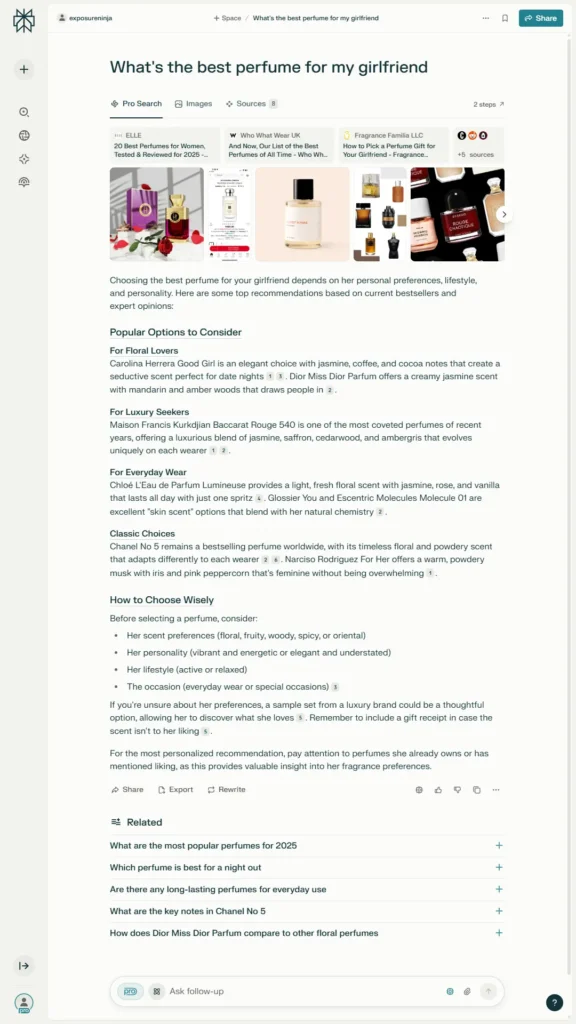
The pattern continues across dedicated AI search platforms like ChatGPT:
- For perfume recommendation queries, Sephora is typically not mentioned at all
- In tinted moisturizer searches — a category where they dominate traditional search — they rarely appear
- When Sephora does get referenced, it’s often just a bland link without meaningful context or prominence in the answers
This invisibility is particularly striking given that queries like “What’s the best perfume for my girlfriend?” represent high-intent, pre-purchase research — exactly the moment when brands want maximum visibility. These are conversations that would have previously led consumers to review sites or blogs where Sephora’s brand presence would have ensured visibility. In the AI search paradigm, these conversations now happen directly with the AI, and Sephora has effectively been excluded from the room.
The Root Cause: Thin Content Strategy
The core issue lies in Sephora’s approach to content. Despite having access to tremendous beauty expertise, they’ve invested minimally in informational content that AI systems rely on to establish topical authority.
The irony is that Sephora clearly understands the value of expertise in their physical stores, where beauty advisors provide personalised recommendations and education. This “high-touch” approach has been central to their brick-and-mortar success. However, they’ve failed to translate this same philosophy to their digital content strategy, creating a disconnect that becomes particularly problematic in an AI search context.
Weak Informational Content
Consider their fragrance guide section:
- Contains minimal substantive information
- “Guides” lead primarily to product category pages rather than educational content
- Lacks statistics, recommendations, or genuine expertise
- Generates fewer than 600 monthly organic visits
- Doesn’t even provide the fragrance quiz that users are actively searching for
This represents a missed opportunity of staggering proportions. Fragrance is one of the most complex product categories in beauty — with notes, accords, families, and longevity all influencing purchase decisions. Consumers actively seek guidance here, evidenced by search volume for "Sephora fragrance quiz" despite no such tool actually existing on their site.
Instead of creating genuinely helpful resources, Sephora offers what amounts to navigational placeholders — thin pages that exist primarily to funnel users to product listings rather than to educate or inform. This approach fundamentally misunderstands both how consumers research complex products and how AI systems evaluate expertise.
%E2%80%9CWith all the expertise and knowledge inside the Sephora organisation, why aren't they producing any of this informational content for themselves?”
Tim Cameron-Kitchen
Founder
The Competitor Advantage
Meanwhile, competitors are creating content that AI search tools naturally gravitate toward:
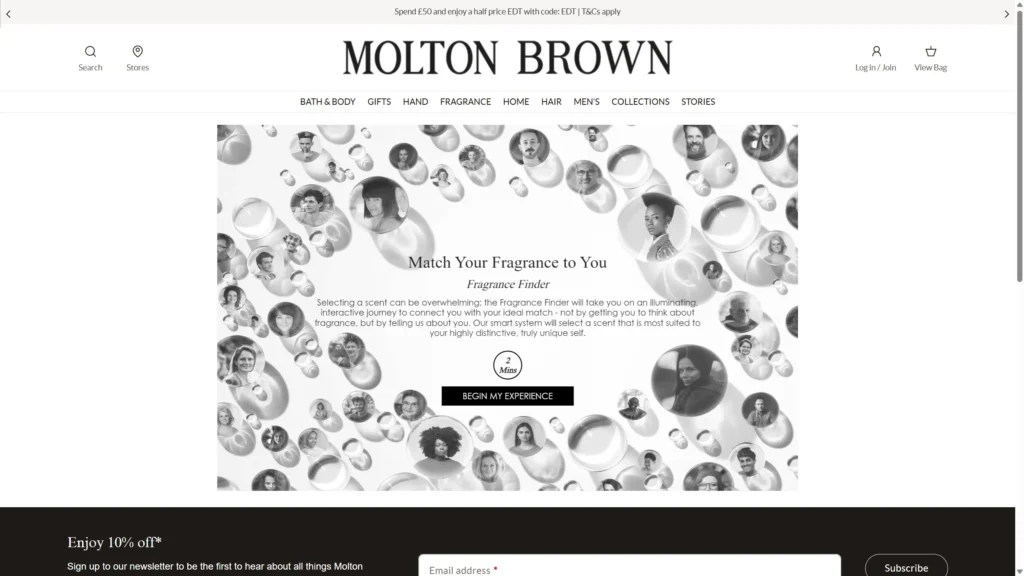
- Molton Brown: Offers comprehensive fragrance guidance with educational content and an interactive fragrance finder
- Perfume Direct: Provides detailed articles on fragrance families with specific examples and educational value
These resources establish topical authority that AI search tools recognise and reference—precisely what Sephora lacks despite its vastly superior resources and industry expertise.
The contrast is particularly striking when examining Molton Brown’s approach. Despite being a much smaller company with fewer resources, they’ve created content that demonstrates genuine expertise. Their guides include the science behind scent composition, explanations of how fragrance notes interact over time, and educational content about ingredient sourcing. This depth signals to AI systems that Molton Brown is a genuine authority on fragrances — not just a retailer that happens to sell them.
Next Steps: What Brands Can Learn from Sephora’s Oversight
Whether you’re an established brand looking to protect your market position or a challenger seeking to gain ground, Sephora’s AI search invisibility offers valuable lessons:
For Established Brands:
- Audit your AI search visibility: Use tools like Semrush* to analyse your presence in AI search results compared to traditional rankings
- Develop expertise-driven content: Create comprehensive guides, tutorials, and educational resources that demonstrate genuine expertise in your field
- Leverage your internal knowledge: Transform the expertise within your organisation into valuable content assets that AI can reference
- Balance product and informational content: Don’t rely solely on product pages; build a content ecosystem that addresses the full customer journey
For dominant brands, addressing this vulnerability requires more than just adding content — it demands a strategic shift in how they conceptualise their digital presence. This should begin with a comprehensive audit comparing AI search visibility to traditional search rankings, identifying specific gaps where high-traffic pages are being excluded from AI results.
The next step involves tapping into the expertise that already exists within the organisation. Beauty advisors, product developers, and brand partners all possess valuable knowledge that can be transformed into authoritative content that AI systems will recognise and reference.
For Challenger Brands:
- Identify AI search gaps: Look for categories where dominant players lack AI search visibility
- Create depth where competitors offer breadth: Focus on creating exceptionally detailed content in specific niches
- Lead with expertise: Position your brand as an industry thought leader through informational content
- Optimise specifically for AI consumption: Structure content with clear headings, concise facts, and easily extractable information
For challenger brands, Sephora’s AI search vulnerability represents a rare opportunity to gain visibility against an entrenched competitor. The key is to identify specific categories where you can create exceptional depth of content — even if you can’t match the breadth of larger competitors.
This might involve becoming the definitive resource for a specific niche within the broader category. By establishing overwhelming expertise in these specific areas, smaller brands can secure AI search visibility for these targeted queries while circumventing the traditional SEO advantages of larger competitors.
Resources Mentioned
- Semrush* — The analysis tool used to examine Sephora’s search visibility and AI search presence
- Adobe’s research — Study shows the 1,300% increase in AI search referrals during the holiday season
- Interbrand — Source for Sephora’s $7.2 billion brand valuation
- AdClarity* — Source for Sephora’s estimated $34 million ad spend
In Conclusion
Sephora’s current position illustrates a critical inflection point in digital marketing. Despite building a $7.2 billion brand and dominating traditional search, they stand remarkably vulnerable to the AI search revolution transforming how consumers discover and select products.
This disconnect creates both warning and opportunity. For established brands like Sephora, it signals the urgent need to evolve content strategies beyond traditional SEO parameters. For challengers, it reveals a rare opening to gain visibility against entrenched competitors by prioritising informational depth over breadth.
The beauty industry is particularly susceptible to this shift given the complex, education-intensive nature of many products. Consumers don’t just want to know what to buy — they want to understand why certain ingredients matter, how to use products effectively, and what science supports various claims. This educational dimension creates natural opportunities for brands to demonstrate expertise through content.
As AI search continues its rapid growth trajectory, the brands that recognise and address this shift earliest will secure substantial advantages. The beauty of this opportunity? Unlike many digital transformations that require massive infrastructure investments, succeeding in AI search primarily demands a strategic reorientation of existing content resources.
The question now isn’t whether AI search will reshape digital discovery — it’s already happening. The real question is whether your brand will be visible when consumers ask AI for recommendations in your category.
Watch This Next
Watch our on-demand video with our core team of AI search experts, in which they explain how to create a next-level generative engine optimisation strategy that ensures your brand gets featured on key growth platforms like ChatGPT and Perplexity.
*Some links within this article are affiliate links which Exposure Ninja receives a fee for promoting. Exposure Ninja only promotes services we already use within our marketing stack