Have Google’s AI Overview Ranking Factors Been Revealed?

The search landscape is shifting beneath our feet, and marketing leaders who fail to adapt are watching their organic traffic evaporate.
Google continues to roll out AI Overviews globally. In May, an average of 17% of UK mobile searches returned an AI Overview — up from just 14% in March — and predictions within our team, here at Exposure Ninja, point to possibly 30% coverage by year-end.
The million-pound question every marketing director is asking: What actually determines which brands get featured in these AI-powered results?
A fantastic study from Ahrefs has just analysed 75,000 brands to uncover the ranking factors that influence AI Overview mentions. The findings challenge everything we thought we knew about search optimisation and reveal why your meticulously crafted backlink strategy might be missing the mark entirely.
Executive Summary
The Brand-First Revolution
Ahrefs’ comprehensive analysis reveals that brand signals dominate AI Overview ranking factors, with branded web mentions showing the strongest correlation to visibility.
Key Findings:
- Branded web mentions emerged as the most influential factor
- Branded anchors and branded search volume followed as secondary signals
- Traditional metrics like ad traffic and ad cost showed weak correlation
- Brand strength trumps technical SEO optimisation
This represents a fairly large required strategic shift from link-equity-focused strategies to comprehensive brand-building approaches that span your entire digital presence.
The Data That’s Changing Everything
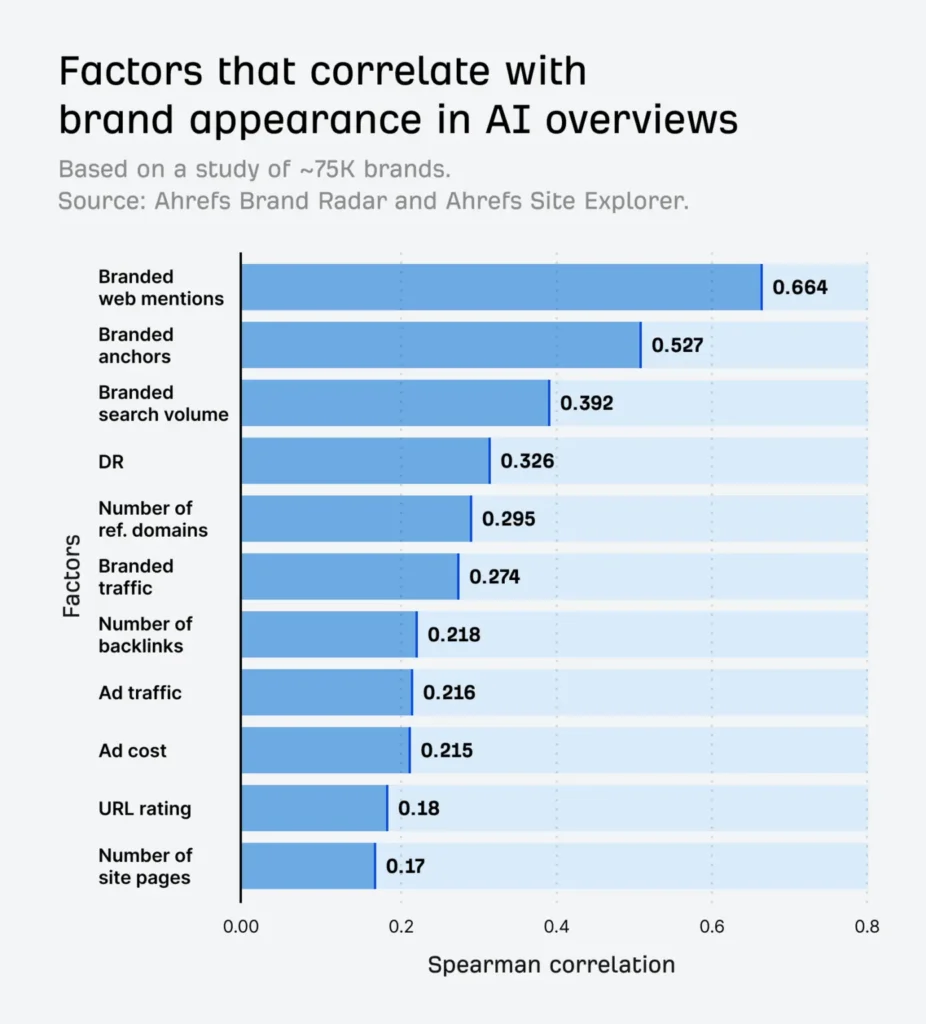
The Ahrefs study employed Spearman coefficient correlation analysis across 75,000 brands, measuring factors on a scale from -1 to +1. While the researchers acknowledge these represent “moderate to weak relationships,” the pattern is unmistakable: brand signals consistently outperform traditional ranking factors.
Think of it like assembling a jigsaw puzzle without the box. You don’t have every piece, but you’ve got enough to recognise the Mona Lisa emerging from the fragments.
What the Numbers Actually Mean
The correlation data reveals a striking hierarchy of influence factors. At the summit sits branded web mentions with a 0.664 correlation — nearly double the strength of any traditional SEO metric. This isn’t a marginal difference; it’s a fundamental shift in how search algorithms evaluate authority.
The Brand Dominance Tier (High Correlation):
- Branded web mentions: 0.664 — The clear winner
- Branded anchors: 0.527 — Still brand-focused, but lower impact
- Branded search volume: 0.392 — Brand awareness translates to visibility
The Traditional SEO Tier (Moderate Correlation):
- Domain Rating (DR): 0.326 — Your domain’s overall authority
- Number of referring domains: 0.295 — Quality backlink diversity
- Branded traffic: 0.274 — Existing organic performance
The Surprisingly Weak Tier (Low Correlation):
- Number of backlinks: 0.218 — Quantity matters less than expected
- Ad traffic: 0.216 — Paid visibility doesn’t translate
- Ad cost: 0.215 — Expensive keywords don’t guarantee AI inclusion
- URL rating: 0.18 — Page-level authority loses significance
- Number of site pages: 0.17 — Site size becomes irrelevant
This hierarchy reveals that AI systems prioritise brand recognition and discussion over traditional link-building metrics. In theory, your £50,000 link-building campaign might deliver a 0.218 correlation boost, while a strategic PR campaign generating unlinked brand mentions could deliver a 0.664 impact. However, for effective results in AI Search Optimisation and SEO, you’ll likely need to do both.
Why Brand Mentions Trump Backlinks
The correlation data reveals a stunning reality: branded web mentions (0.664) are more than three times as influential as the total number of backlinks (0.218). This represents the largest shift in search optimisation priorities since Google’s original PageRank algorithm.
Google’s AI systems have evolved beyond the traditional link-centric model for a fundamental reason: publishers rarely link back to sources anymore. Major news outlets like The Guardian have editorial policies that discourage external linking, creating a massive gap in the traditional backlink ecosystem.
The Mathematical Reality
Consider the stark difference in correlation strength:
- Branded web mentions: 0.664 correlation
- Number of backlinks: 0.218 correlation
- URL rating: 0.18 correlation
This means an unlinked mention of your brand in a Forbes article may carry significantly more AI ranking weight than dozens of traditional backlinks. The implications for marketing budgets are profound.
%E2%80%9CThe days of backlinks being more important than unlinked general brand mentions are starting to move behind us now”
 Charlie Marchant
CEO
Charlie Marchant
CEO
The Logic Behind the Shift
Google’s engineers have likely designed AI systems that can assess brand authority without relying solely on hyperlinked citations. This should make perfect sense when you consider:
- Publisher reluctance to link externally
- Pay-to-play dynamics in traditional link building
- Unlinked brand mentions across forums, social media, and news sites
- AI’s ability to understand context without explicit linking signals
The result? A ranking system that evaluates brand strength through mentions, discussions, and references across the entire web ecosystem — not just linked citations.
The Expanding AI Overview Landscape
The urgency around this shift becomes clear when you examine the growth trajectory. AI Overviews appeared in 14% of UK mobile searches in March 2024. By recent measurements, that figure has climbed to 17% and shows no signs of slowing.
With Google’s AI Mode launching in the US and expanding rapidly, our team predicts that AI-powered search results will dominate 30% or more queries by year-end. This isn’t a distant future scenario — it’s happening now.
What This Means for Your Traffic
Businesses that haven’t proactively optimised for AI Overview inclusion are already reporting declining organic traffic. The mathematics are brutal: if 30% of searches feature AI Overviews and you’re not included, you’ve effectively lost access to nearly one-third of potential organic visibility.
The companies investing in AI optimisation now are establishing competitive moats that will become increasingly difficult to overcome as this technology reaches mainstream adoption.
Measuring Your AI Visibility Today
Understanding your current AI presence requires specialised tools that track brand mentions across AI platforms. Traditional SEO tools weren’t designed for this new landscape, but solutions like Semrush’s brand new AI Toolkit (which you can try via exposure.ninja/ai-toolkit*) provide comprehensive visibility tracking.
Essential Metrics to Monitor
Market Share Analysis — Track your brand’s percentage of mentions across AI platforms compared to competitors. This reveals your relative authority in your sector and highlights improvement opportunities.
Sentiment Analysis — Monitor whether AI systems present your brand positively or negatively. The Semrush tool breaks this down into specific sentiment drivers, showing exactly what factors contribute to positive brand perception.
Topic Authority — Understand which subjects your brand is associated with in AI responses. This helps identify content gaps and positioning opportunities.
The Integration Imperative
The most successful AI optimisation strategies don’t operate in isolation. They integrate seamlessly with your existing marketing efforts to create consistent brand signals across all channels.
Breaking Down the Silos
Traditional marketing departments often operate with rigid divisions: SEO here, PR there, social media in another corner. AI optimisation demands a more integrated approach where:
- Content marketing reinforces brand messaging across owned channels
- Digital PR secures brand mentions on authoritative third-party sites
- Social media amplifies brand discussions and generates user-generated content
- Event marketing creates real-world brand associations that translate to online mentions
- Traditional PR builds offline brand authority that influences online perception
The Compound Effect
When these efforts work in harmony, they create a compound effect that dramatically increases your brand’s AI visibility. A speaking engagement leads to media coverage, which generates social discussion, which influences how AI systems understand your brand authority.
Making Complexity Simple for Stakeholders
One of the biggest challenges in implementing AI optimisation strategies is securing buy-in from senior leadership. The technical complexity can be overwhelming, and executives need clear, actionable insights.
Translating Data into Business Language
Instead of drowning stakeholders in correlation coefficients and technical jargon, focus on business-relevant metrics:
- Brand Mention Volume (not “Attribution Rate in AI Outputs”)
- Share of Voice (not “LLM Answer Coverage”)
- Topical Authority (not “Vector Index Presence Rate”)
- Linked Mentions (not “Chunk Retrieval Frequency”)
ROI-Focused Reporting
Senior leaders care about bottom-line impact. While SEO and AI optimisation are long-term investments, your reporting should include clear progress indicators:
- Month-over-month brand mention growth
- Share of market growth
- Topic authority improvements
- Ultimately, organic traffic and conversion trends
%E2%80%9CSimple reporting is effective reporting. The more stuff you try and cram into a report, the more things you talk about, the more confusing it becomes”
Charlie Marchant
CEO
Next Steps
Ready to position your brand for the AI-powered search future? Here’s your immediate action plan:
Immediate Actions (This Week)
- Audit your current AI visibility using tools like Semrush’s AI Toolkit*
- Benchmark against competitors to understand your relative position
- Identify your brand’s current sentiment drivers and areas for improvement
Short-Term Strategy (Next 30 Days)
- Integrate your marketing teams to create consistent brand messaging
- Prioritise topics where you want to establish thought leadership
- Launch a brand mention monitoring system to track progress
Long-Term Investment (Next 90 Days)
- Develop a comprehensive content strategy that reinforces your desired brand positioning
- Establish relationships with journalists and industry publications for ongoing PR opportunities
- Create speaker opportunities and thought leadership platforms
- Build a sustainable system for generating authentic brand discussions across multiple channels
The businesses that start this work today will dominate tomorrow’s AI-powered search landscape. Those who wait will find themselves fighting for scraps in an increasingly competitive environment.
Resources Mentioned
- Semrush’s AI Toolkit*
- Ahrefs’ Brand Visibility Factors Analysis
- Sistrix’s Tracking of AI Overviews in the UK
In Conclusion
The evidence is overwhelming: AI Overviews represent a fundamental shift in how search engines evaluate and present brand authority. The businesses that recognise this shift and adapt their strategies accordingly will capture an increasingly valuable share of high-intent organic traffic.
The Ahrefs research provides crucial directional insight, but it’s just the beginning. As AI systems continue evolving, the brands that establish strong mention networks, positive sentiment associations, and topic authority will find themselves consistently featured in AI-powered search results.
Your competitors are already working on this. The question isn’t whether you can afford to invest in AI optimisation — it’s whether you can afford not to.
The future of search is here. Make sure your brand is part of it.
Watch This Next
Google announced many important changes to how its search product will work over the next few years, with the new ChatGPT-like AI Mode search product leaving beta testing and seeing a nationwide release across the United States (which you can learn all about in this video).
To catch up with all the developments, including a brand shopping experience which is going to significantly increase shopping sales without having the leave Google, you should watch last week’s podcast episode: How Google Changed the Future of SEO at Google I/O 2025
*Disclaimer: Exposure Ninja may get a commission through the marked links above, at no cost to you