Marketing RFP: How to Get Better Agency Pitches


This guide explains how to write an RFP for marketing that attracts higher-quality agency proposals. It outlines what to include and how to run the process so that you can select a digital marketing partner with confidence.
A marketing RFP shouldn’t just generate proposals. It should attract the best proposal from a digital marketing agency that:
- Understands your commercial goals.
- Challenges your assumptions.
- Builds a digital marketing strategy designed to deliver measurable results.
Richard Gray, Sales Director at Exposure Ninja, has reviewed hundreds of RFPs from enterprise businesses. His insights reveal exactly what separates RFPs that generate outstanding marketing agency pitches from those that waste everyone’s time.
What Is a Marketing RFP?
A marketing request for proposal (RFP) is a formal document that businesses send to potential agency partners, outlining their marketing needs and inviting proposals for how to address them.
It’s how you go to market and say: “Here’s where we are. Here’s where we want to be. Show us how you’d get us there.”
For enterprise and larger mid-market businesses, a marketing RFP often marks the start of a serious investment. You’re not just buying a service. You’re choosing a partner who’ll influence how your marketing budget gets spent over the coming months or years.
The Real Benefits of a Good Marketing RFP
A properly constructed marketing RFP does more than generate proposals. It sets the foundation for a productive agency relationship from day one.
- You filter out the wrong partners early. The RFP process reveals how agencies think, communicate, and problem-solve before you’ve signed anything.
- You create a level playing field. When every agency receives the same information, you can genuinely compare their approaches, strategies, and pricing.
- You force clarity on what you actually need. Writing an RFP requires you to clearly articulate your goals, challenges, and constraints.
- You save time in the long run. Yes, writing a comprehensive RFP takes effort. But it’s far less effort than conducting discovery calls with multiple agencies that all ask the same basic questions, or spending months working with the wrong partner because expectations weren’t clear from the start.
The businesses that invest time in their RFP process don’t just get better proposals. They get better outcomes.
How To Write an RFP for Marketing To Get Better Results
Based on Richard Gray’s 20+ years of experience in sales, here’s exactly what your RFP marketing document should include to generate better agency proposals that help you make the best decision.
Company Context and Decision-Makers
Start with who you are. Not just your company name and sector, but the details that help agencies understand your business model, scale, and complexity.
Include:
- Your revenue bracket and growth trajectory.
- Key products or services and how you monetise.
- Geographic markets you operate in.
- Size of your marketing team and current capabilities.
- Decision-makers involved in the selection process and their priorities.
This last point matters more than most companies realise. If your CFO cares primarily about ROI proof and your CMO about brand building, agencies need to know that their proposal must satisfy both perspectives.
Crystal-Clear Goals
Vague goals generate vague proposals. “Increase leads” tells an agency almost nothing. “Generate 100 qualified leads per month with a target cost per lead under £300” gives them something to work with.
Describe what you’re trying to achieve in business terms first, then marketing terms. For example:
- Business Goal: Reduce customer acquisition cost by 25% whilst maintaining volume.
- Marketing Implication: Current paid channels show diminishing returns; need to build sustainable organic channels.
This framing helps agencies diagnose whether your proposed solution actually addresses your underlying challenge.
The biggest mistake companies can make in their marketing RFPs is not being open to suggestions. People seek out experts to solve their problems, but often they don’t fully understand what needs to be done. They may issue an RFP for something very specific that, in reality, doesn’t address the root problem that they are having. When you engage experts, you should allow them to diagnose what you actually need instead of dictating what the solution needs to be
 Richard Gray
Sales Director
Richard Gray
Sales Director
Current State and What You’ve Tried
Agencies need to know your starting point. How close are you to your goals right now? What have you already attempted?
Be honest about what’s worked, what hasn’t, and why you believe that. If your previous SEO agency failed to deliver, was it their strategy, your internal constraints, or market conditions? This context prevents agencies from proposing solutions you’ve already proven won’t work in your specific situation.
Include current metrics where possible:
- Website traffic and conversion rates.
- Lead volumes and costs per channel.
- Campaign performance data.
- Team capabilities and resource constraints.
Timeline and Budget
A strong marketing RFP sets clear commercial parameters around timeline and budget.
Vague deadlines weaken strategy. “As soon as possible” provides no basis for planning. A clear goal with a fixed deadline, such as “Increase online revenue by 30% before Q4 peak season,” gives agencies a defined target to work back from and assess feasibility.
A clear timeline also signals internal commitment. It shows that the project has urgency and executive backing. Without it, agencies are forced to make assumptions, which weakens the quality of their proposals.
Budget causes the most friction in RFP marketing processes, with many companies reluctant to disclose figures.
As Richard Gray explains: “It’s understandable why some companies choose not to disclose it. However, leaving it out can lead vendors to spend significant time proposing solutions that are simply not feasible. The budget doesn’t need to be exact, but providing a range helps vendors determine whether it’s worth responding and ensures their proposal is pitched at the right level.”
A precise figure is not required, but a range is essential. If you are evaluating options between £15,000 and £25,000 per month, say so.
Competitive Landscape
Who are you competing against, and what are they doing better than you?
Agencies need to understand the competitive pressure you’re under and the benchmark you must match or beat. Without that context, proposals are built with missing context.
If your primary competitor ranks for every high-intent keyword while you sit on page three, the scale and speed of Search Engine Optimisation (SEO) investment required will be very different. If they are aggressively investing in paid media, content marketing, or digital PR, that directly affects the budget and channel mix needed to compete.
This becomes even more critical with AI Search Optimisation.
If you are losing visibility in AI-generated answers across tools like ChatGPT, Google’s AI Overviews, or Perplexity, that signals an AI Share of Voice (SoV) issue, not just a rankings issue. Agencies need to know:
- Which competitors are cited in AI answers?
- Which brands dominate high-intent prompts?
- Where is your brand absent entirely?
Including competitor names, perceived strengths, positioning, and any internal analysis allows agencies to build realistic, data-driven proposals. It prevents recommendations that ignore the search and AI visibility dynamics in your sector.
What Makes You Different
Agencies cannot position your brand effectively unless they understand what truly sets you apart.
Clear differentiators influence:
- Channel selection
- Messaging hierarchy
- Content priorities
- Paid media angles
- SEO and AI Search positioning
For example, if your core strength is 24-hour UK-based support, but your website barely references it, that gap matters. Agencies need to know where your operational strengths are not being fully leveraged in your current marketing.
Including this context in your marketing RFP ensures proposals are built around your actual competitive advantage.
RFP Process Timeline
Set out clearly what will happen and when.
Agencies need visibility of the process so they can allocate the right people, plan resources, and decide whether to participate. A typical structure might include:
- RFP issued
- Q&A window
- Proposal submission deadline
- Shortlist notification
- Presentation dates
- Final decision
- Expected project start date.
Clarity creates confidence. It signals that the process is structured and that internal stakeholders are aligned.
It is equally important to respect the timeline you set. If proposals are due in two weeks, avoid repeated deadline extensions. This signals a lack of organisation and can cause serious agencies to question whether the project is ready to proceed.
At the same time, avoid unrealistic expectations. Complex, strategic pitches require research, internal collaboration, and senior input. If you expect deep thinking, tailored strategy, and commercial modelling, you cannot reasonably expect it within a week.
Evaluation Criteria
Be explicit about how proposals will be assessed.
Agencies need to understand what matters most to your organisation so they can respond accordingly. If the CFO has final approval and places strong emphasis on cost efficiency, agencies need to know that the commercial structure will be scrutinised closely. If the CEO requires experience working with organisations of similar size or complexity, that becomes a key qualification criterion.
Transparency here improves the quality of submissions. It ensures agencies focus on the areas that align with your decision-making priorities rather than guessing what will resonate.
What a Good RFP Looks Like
You don’t need a 40-page document. You need a clear, structured brief that respects your time and that of the agency.
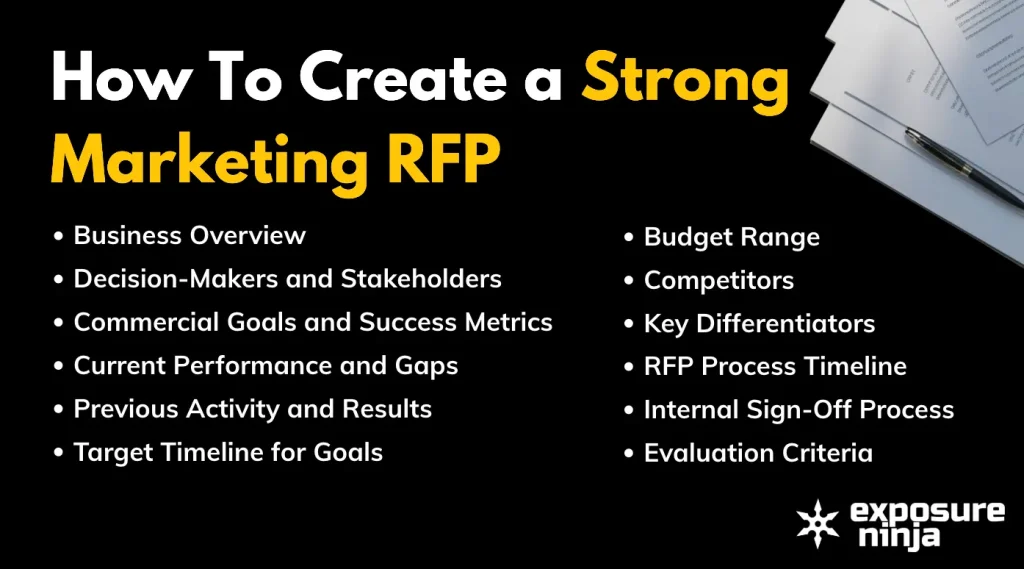
A strong marketing RFP includes:
- A brief overview of your business and the decision-makers involved.
- Clear commercial goals and what success looks like.
- Your current performance and how close you are to those goals.
- What you’ve already tried and the results achieved.
- The timeframe for achieving your objectives.
- A realistic budget range.
- Key competitors and market context.
- What makes your business genuinely different.
- The RFP timeline, including submission, shortlist, and decision dates.
- Your internal sign-off process.
- How proposals will be evaluated and what you expect to see.
Clarity in these areas leads to sharper thinking, stronger proposals, and a more efficient digital marketing agency selection process.
How to Run the Marketing RFP Process So It Works
Writing the marketing RFP is half the work. Running the process effectively determines whether you actually end up with the right digital marketing partner.
Engage Your Own Sales Team First
Richard Gray’s advice here is brilliant: “Engage with your sales team and ask them if the shoe was on the other foot, what information would they like to see on an RFP.”
Your sales team writes proposals all the time. They know exactly which information helps them craft compelling, accurate responses.
They’ll tell you which questions in your draft RFP are too vague, which requirements contradict each other, and what’s missing that would actually help agencies propose better solutions.
Ensure Internal Alignment Before You Send
Nothing wastes more time than discovering halfway through the RFP process that your CFO hasn’t actually approved the budget, or that your CEO has different goals than what you put in the brief.
This is Richard Gray’s biggest piece of advice to marketing leaders writing an RFP: “Ensure that everyone who needs to approve the project agrees on both the need for it and the budget. Too often, companies go out to tender speculatively, when in reality not all stakeholders are aligned, or the funds are not available at the level being implied.”
Get sign-off on your goals, budget, and decision criteria before you involve external agencies. Otherwise, you’re asking people to invest time in a process where the goalposts might move or disappear entirely.
Discovery Calls Are Non-Negotiable
Here’s where many companies get it wrong. They send an RFP, expect detailed proposals back, then hold presentations to compare options.
An important step that is missed in this approach is the discovery call.
Richard Gray explains: “I won’t engage with an RFP unless the groundwork in a discovery call has been done. Sales should be about being the doctor, not the waiter. A waiter simply takes an order and brings what the customer asks for, without question. A doctor asks questions to understand what’s really wrong before prescribing a solution.
An RFP is much the same. Just because a client believes they know what they want doesn’t mean it’s the right solution. The real value comes from sales jumping on a call and actually diagnosing the problem first, then recommending what will actually fix it.”
FAQs
What is an RFP in marketing?
A request for proposal (RFP) in marketing is a formal document sent to agencies outlining your marketing challenges, goals, and requirements. Agencies respond with detailed proposals showing how they’d address your needs, including strategy, approach, timeline, and costs. It’s how enterprise businesses typically initiate relationships with new marketing partners.
What’s the difference between a marketing RFP and RFQ?
A request for quotation (RFQ) focuses on price. You have already defined the scope of work and simply want suppliers to quote for delivering it. A marketing RFP asks agencies to determine the approach and the cost.
What’s the difference between a marketing brief and an RFP?
A marketing brief typically goes to an existing agency partner for a specific project or campaign. An RFP goes to multiple potential partners to find the right one for an ongoing relationship.
How many agencies should you invite to an RFP?
Three to five agencies is the sweet spot. Fewer than three, and you don’t have enough comparison points. More than five, and you’re drowning in proposals without gaining additional insight.
How long should a marketing RFP process take?
Plan for 4-6 weeks from RFP issue to final decision. This allows time for proposal development, presentations, and internal evaluation without rushing critical decisions.
What are the biggest mistakes companies make with RFPs?
The biggest mistake is prescribing a specific solution instead of clearly defining the underlying problem and inviting expert recommendations. A close second is withholding budget information, which leads to unrealistic proposals and wasted time. Third is launching the RFP before stakeholders align on goals, budget, and evaluation criteria, causing shifting expectations mid-process.