Microsoft Advertising in the AI Era: What Google Advertisers Are Missing

There are over a billion unique users across the Microsoft ecosystem, and Bing itself has passed one billion monthly users. On average, people spend four or more hours inside that ecosystem, because it covers work, play and everything in between.
That makes Microsoft Ads far more than a low-volume Google Ads duplicate. But treating it as one is exactly why most accounts underperform.
In a recent live session hosted by Charlie Marchant, CEO of Exposure Ninja, Rebecca Pilkington, Head of PPC at Exposure Ninja, and Navah Hopkins, Product Liaison at Microsoft Advertising, broke down what carries over from Google, what works differently, and what only Microsoft can do.
What Stays the Same When You Move Into Microsoft Ads
Navah Hopkins opened with the framing that matters most before anyone touches an account: “When we think about Google and Microsoft, a lot of folks are used to thinking about Google and Microsoft as pretty much same family, slightly different relation. And while that is true, and remains true for a lot of areas, there are some unique subtleties and really important mechanical differences that if you don’t account for them, can actually limit your ability to succeed on the Microsoft advertising platform.”
Three fundamentals do carry over.
- Conversions matter, because conversion-based bidding cannot work without them. Navah Hopkins recommends setting up conversion tracking from the start and building in two to four weeks for account setup, on either platform.
- Auctions are still decided by ad rank, which means bid plus the components of quality score: expected click-through rate, keyword to ad to landing page relevancy, and landing page experience. This is why behavioural analytics and conversion rate optimisation now sit inside the PPC conversation rather than alongside it.
- Both platforms offer AI-powered campaigns. Performance Max and AI Max are not just automation layers: they are the campaign types most likely to serve on AI surfaces, which tend to carry higher relevancy and higher conversion rates.
For marketing leaders, the practical read is that any Microsoft test needs the same tracking discipline and the same runway you would give Google, before anyone judges the numbers.
Three Mechanical Differences That Change How You Build
The differences are what change the account structure.
- More settings live at ad group level. In Microsoft Ads you can toggle campaign settings off for location targeting, ad scheduling and time zone within an individual ad group. On Google, the same requirement usually means separate campaigns and portfolio bidding. That means fewer campaigns, and fewer campaigns means an easier route to conversion thresholds.
- Search term transparency is greater. As Navah Hopkins puts it: “Microsoft will show you search terms that results in clicks. So if you pay for the click, you’re gonna see the search term.” There are three reports to know: the traditional search term report, the search term insight report for Performance Max, and the new search term landing page report for AI Max.
- There is no forced video in Microsoft Performance Max. If you do not have video assets ready, you can still run a search or display-oriented Performance Max campaign.
That transparency has a commercial use beyond Microsoft itself. Because costs are typically lower, the platform becomes a cheap place to discover keyword concepts worth targeting, and negatives worth applying, before you spend Google money finding the same thing out.
“It is worth noting that the way people are searching is changing, and so an idea that you might have made a negative before, it might be worth holding and actually checking your clarity reports or your behavioural analytics tool of choice. And see if people are actually not converting and the traffic is the problem, or if there might be a landing page issue or conversion tracking issue,” Navah Hopkins, Product Liaison, Microsoft Advertising
Three Things Only Microsoft Ads Can Do
Multimedia ads occupy their own ad slot with its own auction on the Bing results page. They are Copilot eligible, only one advertiser wins the placement, and a text ad of yours can appear alongside it.
Impression-based remarketing is the standout. Navah Hopkins describes it as unique to Microsoft: “On impression-based remarketing, we are the only ad network that has this.” It lets you build GDPR-compliant targeting, exclusion or bid adjustment lists from impressions rather than clicks, with any campaign able to speak to any other campaign, provided at least one audience ad, ad group or campaign sits in the source list of up to 20. The one exception is CTV, which can be a source but not a target.
Her recommendation is a small, always-on audience campaign, in the region of five to ten pounds, dollars or euros, whose only job is fuelling that list. It also surfaces placements worth targeting or excluding on both platforms.
LinkedIn profile targeting exists because Microsoft owns LinkedIn. Over 80,000 companies are available, alongside industry, job function and ten standardised job seniorities. On audience campaigns you can target directly. On search you can use observation or bid adjustment. In Performance Max it works as an audience signal.
If you sell B2B, LinkedIn observation is close to non-negotiable. It tells you how different industries, functions and seniorities respond to your creative, at Microsoft prices, and lets you exclude the personas you never wanted in the mix.
Why B2B Lead Generation Gets Lower Costs on Microsoft Ads
Rebecca Pilkington runs Microsoft accounts as their own thing, not as a copy of Google Ads: “So although there are similarities between the platforms, there are lots of differences and different features, and each platform requires its own strategy within the overarching strategy.”
The pay-off she sees most consistently is cost. Because a high proportion of B2B buyers already spend their working day inside the Microsoft ecosystem, cost per click comes in lower, which pulls cost per acquisition down with it. That headroom is also what makes Microsoft a sensible place to run tests, because the same budget buys more of them.
Broad audience targeting with tight guardrails is the approach. Rebecca Pilkington explains why the guardrails matter: “The guardrails that we put in place so that the PMax and the AI Max don’t go rogue, they’re not landing on FAQ pages and things like that and wasting the budget.”
Placement and search term visibility inside Performance Max is what makes those guardrails possible. You can see where budget is landing, keep what converts, and cut the rest quickly.
“So we love to see that we get a really nice low cost per clicks for our clients on that platform because they’re already hanging out on Microsoft, so we can build a really good strategy for our clients and make use of a similar budget to what we have on Google, and sometimes even a lower budget than what we have on Google. And we can kind of match, or if not, surpass some of the results that we see on Google as well,” Rebecca Pilkington, Head of PPC, Exposure Ninja
Case Study: Fix the Foundations, Then Test, Then Scale
Microsoft offers two routes in:
- Build from scratch
- Or import from Google, Meta, or Pinterest.
Navah Hopkins’ guidance is that a quick import suits accounts you intend to keep at parity with other networks, while anyone planning to use Microsoft’s unique settings is better importing once and then building properly, because the audience behaves differently. It skews more educated and more affluent.
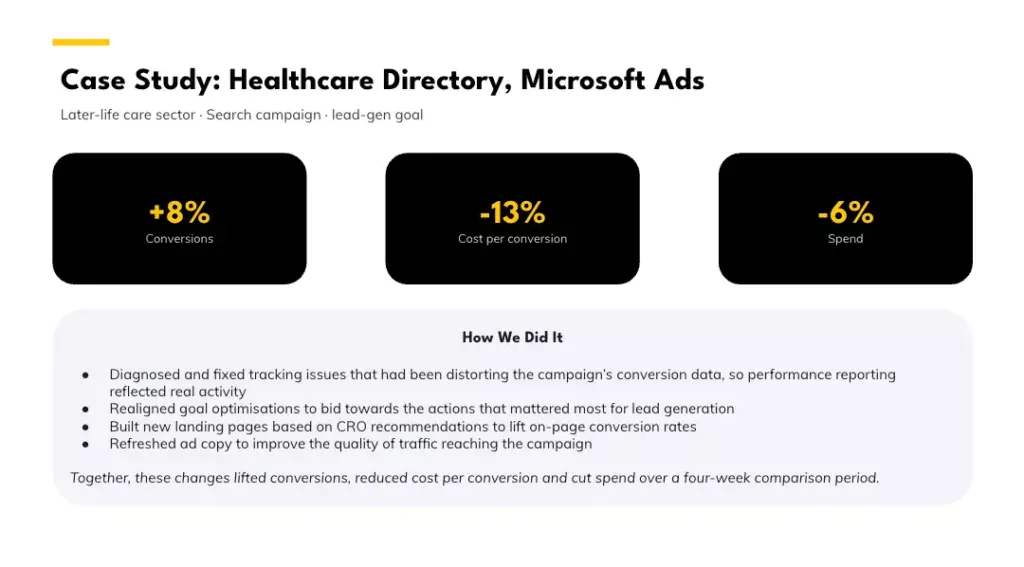
One inherited account showed what happens when the import becomes the strategy. It had been set up as a straight copy of the Google Ads structure, with continuous import switched on, so every Google budget change pushed through automatically and the account kept overspending. Tracking was inaccurate, which meant reporting did not reflect reality and Performance Max was receiving the wrong signals to bid on.
The sequence Rebecca Pilkington used was deliberate: fix the foundations, then test, then scale. Tracking was diagnosed and corrected first, which meant accepting a fresh learning phase, because none of the earlier data had been a reliable signal.
Ad group level settings then did real work. This was a healthcare client with several distinct customer types, each with a different pain point, all heading to the same landing page for the same service. Rather than splitting budget across separate campaigns, each audience could be addressed within one campaign, conserving budget while still hitting conversion thresholds.
With clean tracking and a genuinely Microsoft-specific structure, the low cost per click followed, then lower cost per acquisition, then conversion growth, supported by refreshed ad copy and landing page improvements coordinated with the SEO and email teams.
Set Your Own Tracking Benchmarks, Not Google’s
Importing settings is fine. Importing your benchmarks is not.
Rebecca Pilkington’s position is that Microsoft needs its own goals, measured in Microsoft’s own reporting, and that those goals should go deeper than form fills: “You should be setting up your tracking goals, whether that’s purchases for e-com, whether it’s submitting a lead form, but even getting more granular to what does an MQL look like? What does an SQL look like? Is this a repeat customer? What’s the lifetime value?”
Feeding MQL and SQL definitions, repeat purchase data, and lifetime value back into the platform is what lets bidding optimise towards revenue rather than lead volume. It is also the difference between a campaign that produces enquiries and one that produces a pipeline.
Navah Hopkins makes the same point from the platform side, warning against fixating on clicks, because there are now journeys where someone does business with you without a click being involved at all.
What Your Search Terms Reveal About Your AI Search Visibility
This is the part that reaches beyond the ads team.
Microsoft Clarity is free, and alongside behavioural analytics, it reports the grounding queries your brand is appearing for, the topics involved, and where competitors are taking your share. Read together with Microsoft’s search term reports, that becomes a diagnostic for how AI Search understands your business: “If the search terms that you’re seeing on Microsoft or a platform of choice are completely different than what your grounding queries are, there’s a good chance that you’re being misunderstood, and you might even be pulled into auctions that are too expensive and not even relevant,” explains Navah Hopkins.
The other overlooked lever is feeds. As Navah Hopkins put it: “Feeds are not just for eCommerce.” Lead generation businesses can build a feed in a spreadsheet that spells out exactly what the site offers, field by field, which helps AI systems and ad platforms understand the brand correctly and serve it into the right auctions.
For eCommerce, the fundamentals are a clean feed, accurate pricing, accurate reviews and the full product catalogue exposed. Navah Hopkins illustrated the stakes with a Copilot shopping journey of her own, where switching to a shorter version of the same dress changed the recommended seller entirely, because that seller had a lower price and better reviews.
Much of what appears in Copilot shopping is organic rather than paid, earned simply by making the full catalogue available.
How Much Budget To Start With
There is no flat number, and both speakers resisted giving one. Microsoft’s keyword planner will tell you whether there is meaningful volume for your terms, and the budget works backwards from there, weighed against the value of what you sell.
Three practical guardrails did come out of the session.
- Give it longer than Google. Where you might allow Google two to four weeks to prove something, allow Microsoft four to six, and possibly eight.
- Do not reach for Performance Max or AI Max too early. Until the account has at least five conversions, those campaign types cannot get what they need to work.
- Start with more budget than you intend to spend. Navah Hopkins suggests around 20 to 30% above your intended spend for the first four to six weeks to accelerate learning, then reducing gradually, keeping changes to roughly 15% at a time so campaigns stay stable.
Get Your Microsoft Ads Account Reviewed
If you are not running Microsoft Ads yet, or you are running an imported copy of your Google account and suspecting it could do more, there are three ways to start:
1. A consultation call. One of the team runs a discovery conversation to understand what you are trying to achieve.
2. An account review. Rebecca Pilkington audits your existing account for wasted spend, and you keep the audit either way.
3. A prioritised growth plan. How we would fix what the audit found, built around your business targets rather than PPC metrics alone.
Book a consultation call with one of our marketing consultants to get started.