AI Search to Overtake Traditional Search by 2028

Picture this: it’s Monday morning, and you’re reviewing your quarterly SEO report. Traffic is down 15%, but conversions are actually up. Your agency mentions something about “AI Search Optimisation,” but you’re not sure if it’s just another buzzword or something that genuinely requires your attention.
Here’s the reality: while you’ve been focused on traditional Google rankings, a seismic shift has been quietly reshaping how your customers find and choose products. And according to new research from Semrush, this isn’t a distant future concern. It’s happening right now, and the timeline is more aggressive than most marketing leaders realise.
Executive Summary
The Bottom Line: AI search is projected to overtake traditional search by 2028, potentially faster if Google’s AI Mode becomes the default search experience. But here’s what makes this truly significant for marketing leaders:
- AI search visitors are 4.4x more valuable than traditional search users based on conversion rates
- 50% of ChatGPT citations point to business and service websites
- ChatGPT cites content from positions 21+ almost 90% of the time, creating new opportunities for smaller businesses
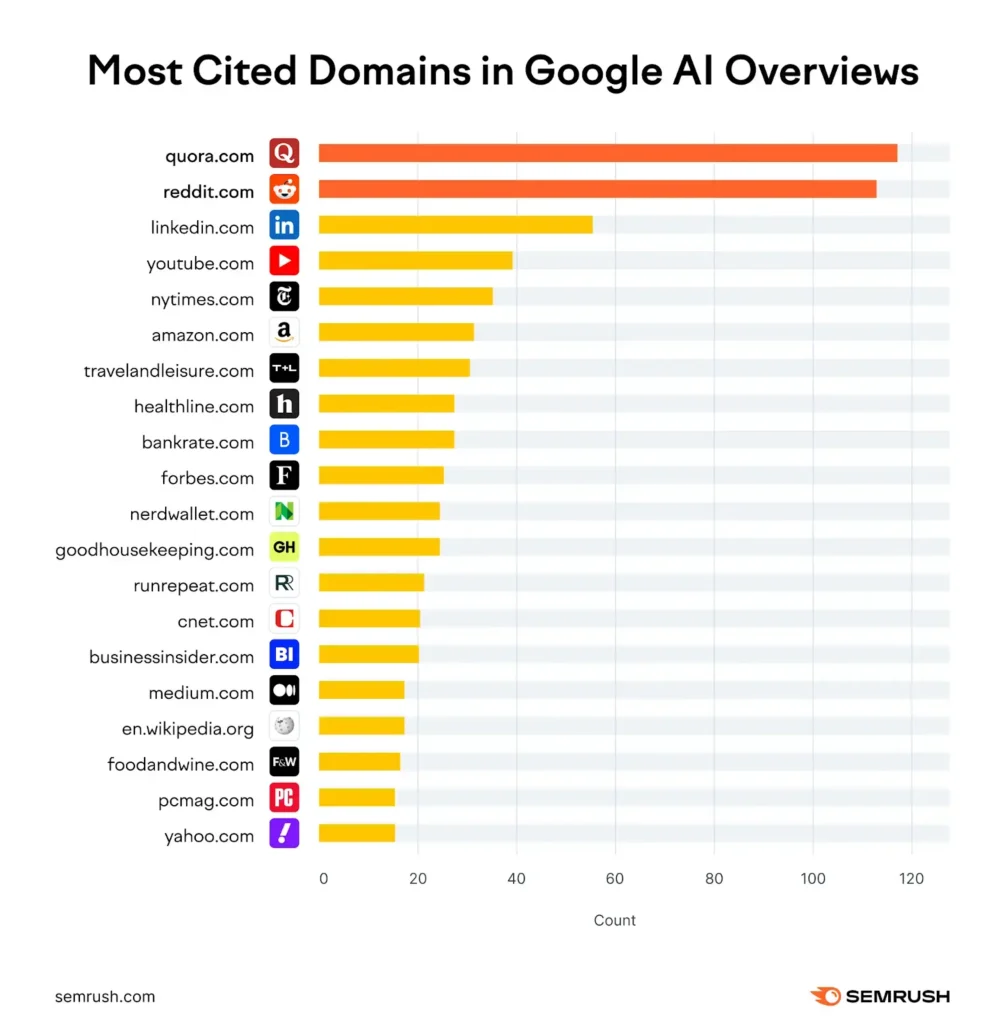
- Quora dominates AI citations, with Reddit ranking second across Google AI Overviews
For marketing leaders, this represents both an unprecedented opportunity and a potential blind spot that, if ignored, could cost significant market share.
AI Search Will Surpass Traditional Search Traffic by 2028 (Maybe Sooner)
Semrush’s comprehensive study analysed over 500 high-value digital marketing and SEO topics, translating them into specific search terms and prompts. Their projection is striking: digital marketing and SEO-related topics may start driving more visitors from AI Search to websites than from traditional search by early 2028.
What accelerates this timeline: If Google’s AI Mode becomes the default search experience, which appears to be the case, this transition could happen much sooner. Google has already started rolling out AI mode, which provides a ChatGPT-like experience and completely replaces the traditional search results page.
The numbers that matter:
- ChatGPT weekly active users grew 8x from October 2023 to April 2025
- Over 800 million weekly active users as of 2025
- Google continues expanding AI Overviews across more query types
What this means for your business: The informational content that used to drive top-of-funnel traffic to your website is increasingly being answered directly by AI. Users no longer need to visit ten different websites to research a purchase decision. Instead, AI compresses the marketing funnel, moving users closer to commercial intent much faster.
This compression explains why conversion rates are higher from AI search users. They’re arriving at your website having already completed much of their research journey, courtesy of AI synthesising information from multiple sources.
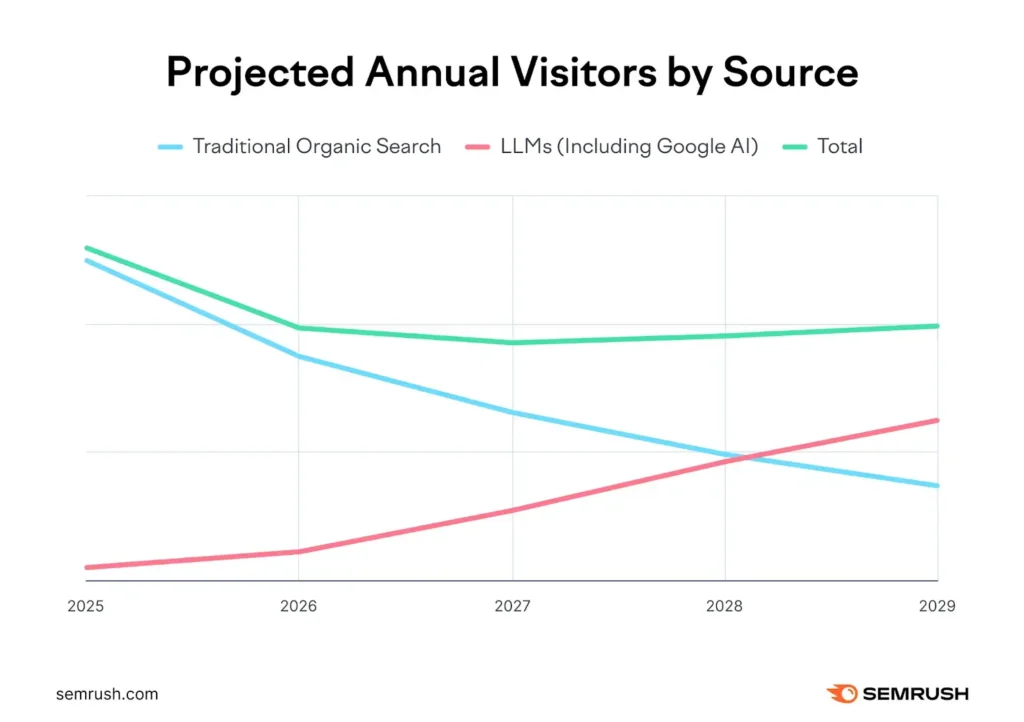
%E2%80%9CThis is the perfect visualization of why marketers actually need to start taking this seriously, and all of the denial that goes on about like, 'it's just SEO'… we really need to get over that.”
 Charlie Marchant
CEO
Charlie Marchant
CEO
The Average AI Search Visitor Converts Better Than Traditional Search
The data reveals something remarkable: the average AI search visitor is 4.4 times more valuable than the average traditional organic search visitor, based on conversion rates.
This isn’t just a statistical anomaly — it reflects a fundamental shift in user behaviour and intent.
The Traditional Journey:
- User searches “best project management software“
- Visits 5-10 comparison websites
- Reads individual product pages
- Searches for reviews
- Finally makes a decision
The AI-Compressed Journey:
- User asks, “what’s the best project management software for remote teams under 50 people“
- AI provides a synthesised answer with specific recommendations
- User visits recommended websites already in evaluation mode
- Makes a decision faster
Why AI users convert better:
- AI equips users with comprehensive information upfront
- By the time they visit your site, they’ve likely compared options and learned about value propositions
- AI responses feel like personal, word-of-mouth recommendations
- Users arrive with higher intent and qualification
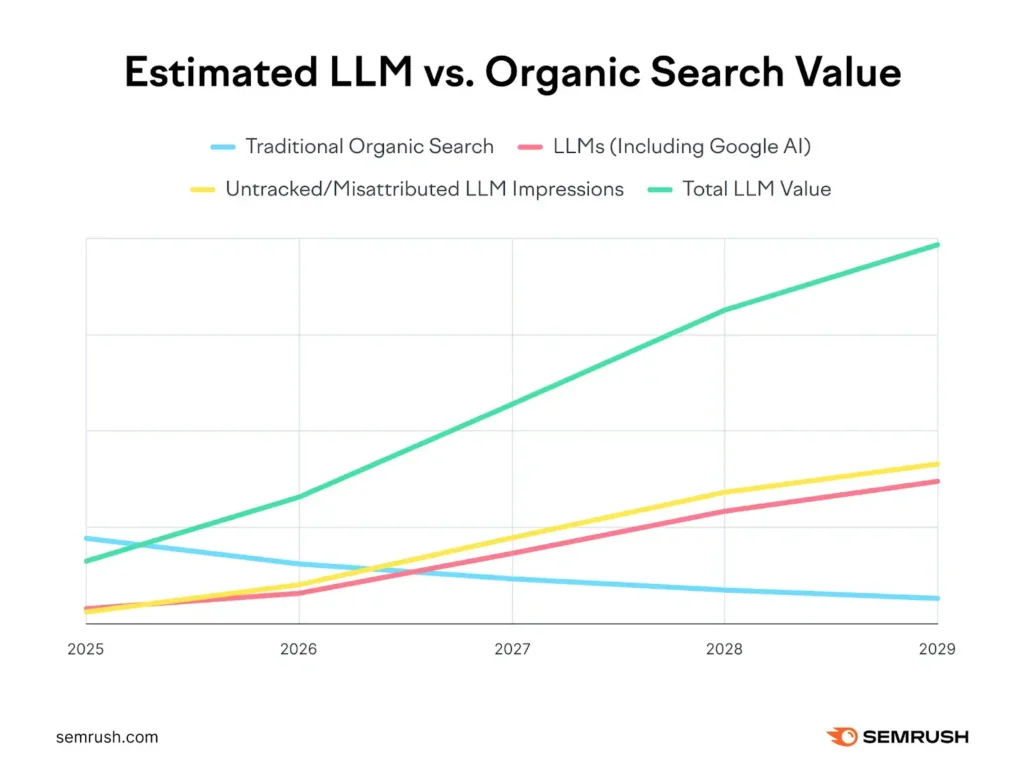
What Semrush’s research projects: AI channels are expected to drive similar amounts of economic value globally by the end of 2027, potentially growing far beyond traditional search in later years.
The implication: Traditional top-of-funnel content metrics (time on page, bounce rate) become less relevant when users arrive with higher intent. Instead, focus on conversion-optimised content that serves users who are already considering your solution.
Your Google Rank Doesn’t Guarantee an AI Mention
One of the most significant findings challenges a core SEO assumption: that you must rank in positions 1-3 to get meaningful traffic.
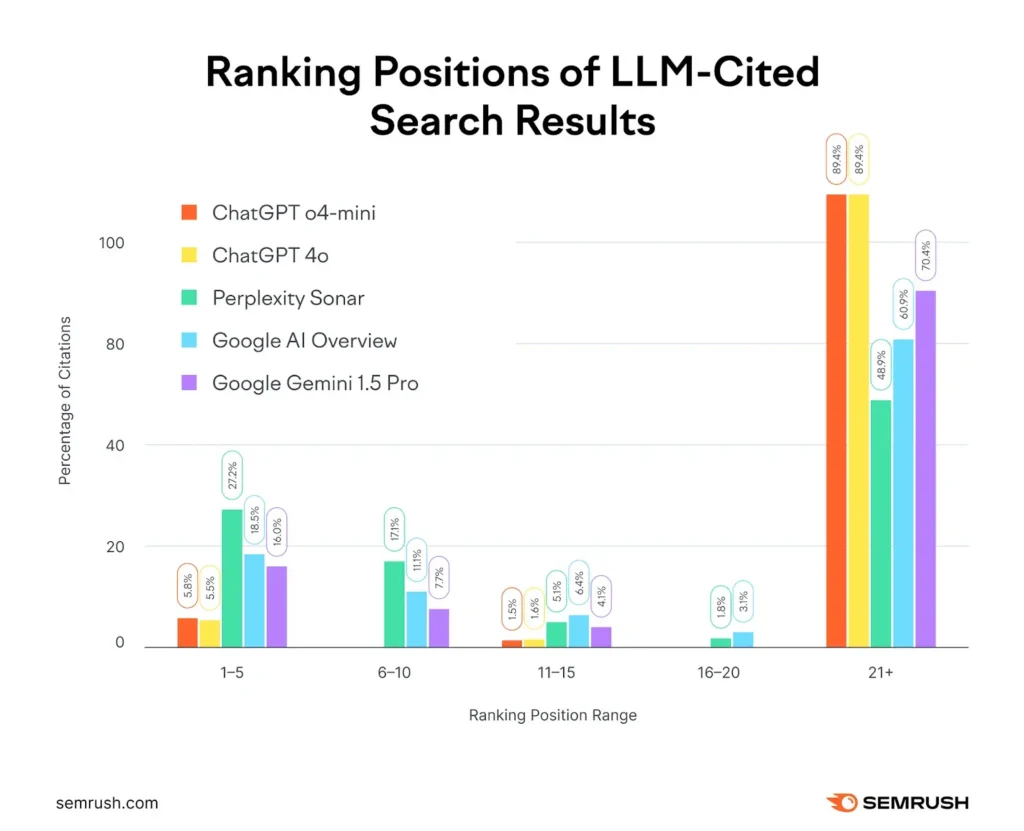
The data is striking: ChatGPT cites webpages ranking in traditional organic search positions 21+ almost 90% of the time. Perplexity and Google’s LLMs also frequently cite pages that rank lower in traditional search results.
However, some LLMs do cite pages ranking in positions 1-5 more often than positions 6-20, suggesting traditional SEO still matters — but it’s not the complete picture.
Why this happens:
- AI systems have access to a larger pool of content in positions 21+
- Information focus over webpage focus — AI prioritises discrete content chunks rather than overall page experience
- Sophisticated intent understanding — LLMs can process natural language more effectively and build user understanding over time
Why this matters:
- Niche expertise beats broad authority when answering specific questions
- Specialised content for specific audiences can outrank generic pages from larger competitors
- Page 2 and 3 rankings suddenly become valuable again
Example in practice: A veteran-focused mortgage broker creating content specifically about VA loans might get cited by AI when someone asks about military mortgage options, even if they rank on page 2 for "mortgage rates." The specificity and relevance trump traditional ranking factors.
%E2%80%9CIf you are measuring traffic on its own in a silo, move away from that. That cannot be the be-all and end-all of SEO now.”
Charlie Marchant
CEO
This creates enormous opportunities for businesses that understand their target audience deeply and create content that serves specific use cases rather than trying to compete on broad, high-volume keywords.
Quora is the Highest-Cited Website in Google’s AI Overviews
The research reveals which types of websites AI search engines prioritise when providing recommendations, and the results may surprise you.
Top-cited domains in Google AI Overviews:
- Quora — Question-and-answer content dominates
- Reddit — User-generated discussions and reviews
- LinkedIn — Professional insights and thought leadership
- YouTube — Video content and tutorials
- New York Times — Authoritative news and analysis
Why Quora and Reddit perform so well:
- Users ask and answer niche questions that aren’t addressed elsewhere
- Rich information sources for highly specific AI prompts
- Google has partnerships with Reddit and uses Reddit data to train its systems
- First-person experiences carry significant weight in AI responses
What this tells us about AI preferences:
- User-generated content influences AI recommendations heavily
- Professional platforms provide credibility signals
- Authoritative publications remain important for factual backing
- Conversational formats align with how AI processes information
The strategic implication: Your visibility strategy must extend beyond your own website. AI search rewards businesses that have a distributed presence across multiple content types and platforms.
This doesn’t mean gaming Reddit or Quora — it means genuinely participating in conversations where your expertise adds value, contributing to professional discussions on LinkedIn, and ensuring your brand appears in legitimate reviews and discussions across the web.
50% of ChatGPT’s Links Point to Business/Service Websites
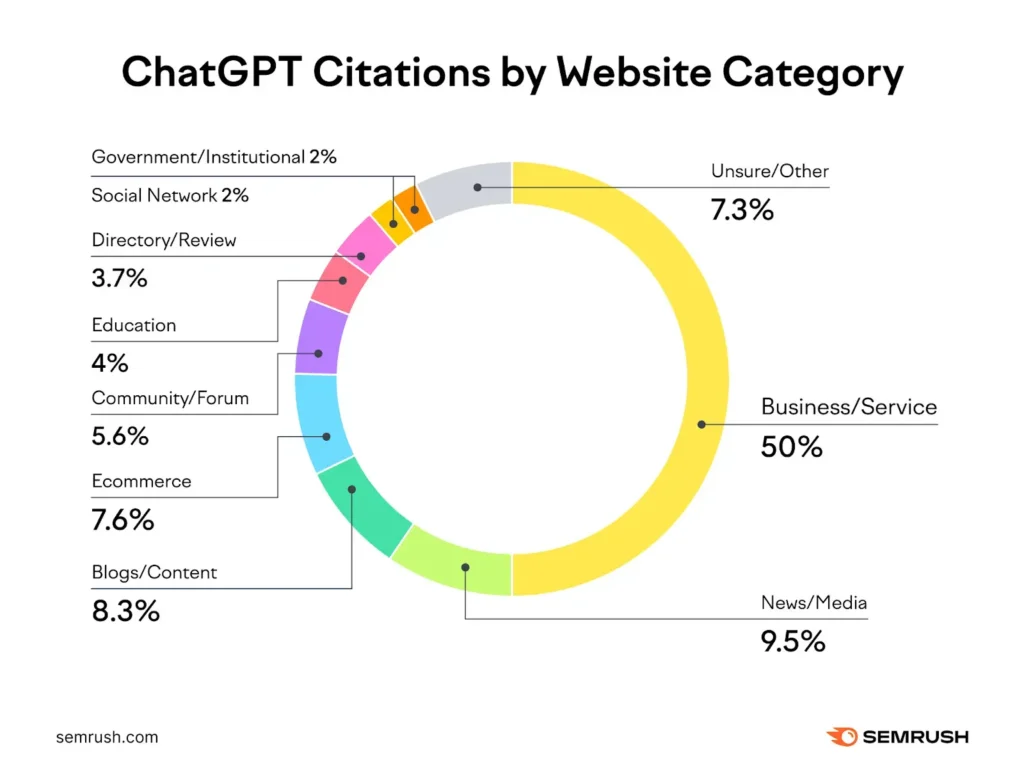
Despite Quora and Reddit’s individual domain dominance, there’s encouraging news for businesses: 50% of links included in ChatGPT 4o responses point to business and service websites.
The breakdown of ChatGPT citations:
- 50% Business/service websites — Your company website and similar business sites
- News/media — Less than 10% in each category
- Blogs/content — Independent content creators and publications
- E-commerce — Product and retail sites
- Community/forums — Including Reddit and similar platforms
- Education — Academic and educational institutions
- Directory/review — Yelp, TripAdvisor, and similar platforms
What this means: LLMs often rely heavily on your website when generating responses about your business and frequently consider business websites to be authoritative sources of topical information.
The opportunity: Your website has strong potential to get cited in AI responses — but you need to create the right kinds of content and make it LLM-friendly.
Content formats AI favours:
- Concise, factual snippets that can be easily quoted
- Statistical data points (increase citation probability significantly)
- Clear FAQ sections addressing specific questions
- Well-structured headings and lists
- Comparison guides that help users understand options
Content that performs poorly:
- Long-form narrative without a clear structure
- Promotional content without factual backing
- Poorly formatted information that’s difficult to extract
Your Action Plan for AI Search Success
Based on the research, here’s your three-step action plan:
Step 1: Audit Where You Stand (Week 1)
- Test your key terms in ChatGPT, Google AI mode, and Perplexity
- Note which competitors appear and how your brand is represented
- Use the Semrush AI Toolkit* to track your visibility against competitors
Step 2: Optimise Your Foundation (Month 1)
Content priorities:
- Add FAQ sections to key product pages
- Include statistical data and clear headings in existing content
- Create niche content for specific use cases (not broad topics)
Technical basics:
- Ensure your website is easily crawlable
- Add schema markup to help AI understand your content structure
Step 3: Expand Your Presence (Month 2-3)
Build distributed visibility:
- Contribute expert insights to industry publications
- Participate meaningfully in relevant LinkedIn and Reddit discussions
- Encourage authentic customer reviews across platforms
Track and refine:
- Monitor citations in AI responses
- Measure conversion rates from AI traffic
- Adjust strategy based on what’s working
Quick wins you can implement this week:
- Add FAQ sections to your most important pages
- Update content with clear bullet points and statistical data
- Complete your Google Business Profile
Resources Mentioned
- Semrush’s AI Search Study — Comprehensive analysis of AI search trends and projections
- Semrush Enterprise AIO — Enterprise-level AI visibility tracking and analysis
- Semrush AI Toolkit* — AI visibility analysis for smaller businesses
In Conclusion
The shift to AI search isn’t a distant future scenario — it’s happening now, and the businesses optimising for it today will establish an insurmountable advantage as adoption accelerates.
While AI search represents a significant change, it’s not a complete departure from good marketing fundamentals. Quality content, expertise, and understanding your audience remain crucial. The difference is how and where you deploy these assets.
The 4.4x higher value of AI search users should be reason enough to prioritise this channel. But beyond immediate returns, positioning your brand as a trusted source in AI responses will compound over time as more users adopt AI-powered search.
The bottom line: AI Search traffic has the potential to overtake traditional organic search traffic within the next two to four years. If you don’t start optimising for LLMs now, competitors could establish themselves in AI results and capture the majority of available exposure and visits.
The question isn’t whether AI search will become dominant — the data makes that clear. The question is whether you’ll be ready when it does.
Watch This Next
The ranking factors for Google’s AI Overviews have repeatedly been analysed, but one of the most compelling studies is this one by the team at Ahrefs: An Analysis of AI Overview Brand Visibility Factors (75K Brands Studied)
Charlie and Dale analysed and discussed this study and broke down everything you need to know in this episode of the Dojo: Have Google’s AI Overview Ranking Factors Been Revealed?
*Disclaimer: Exposure Ninja may get a commission through the marked links above, at no cost to you