
How to Measure Content Marketing ROI


Content marketing ROI measures the revenue generated from your content compared to what you spent creating and promoting it. This guide breaks down how to calculate it, why it’s tricky to track, and how to uncover the hidden wins that drive real growth.
Content marketing return on investment (ROI) tells you the return you get for every pound spent on your blogs, videos, emails, and other content efforts. It’s how you prove your content isn’t just raising awareness or improving search rankings — it’s helping generate revenue.
And this isn’t just about impressing your boss or board. Measuring ROI gives you the insights needed to sharpen your content marketing strategy by showing you what’s working, what’s wasting your budget, and where to invest more for better results.
With PPC, ROI is easier to calculate. If an advert leads to 1,000 extra visits to your website, five of which turn into sales, you’ve got a 0.5% hit rate. You can then work out how much you paid per sale and calculate your ROI.
Content marketing isn’t that simple. Someone might read a blog today, download a guide next month, and convert after attending a webinar three months later. The path from first touch to sale is longer and more complex, but that doesn’t make ROI any less important.
How to Calculate Content Marketing ROI
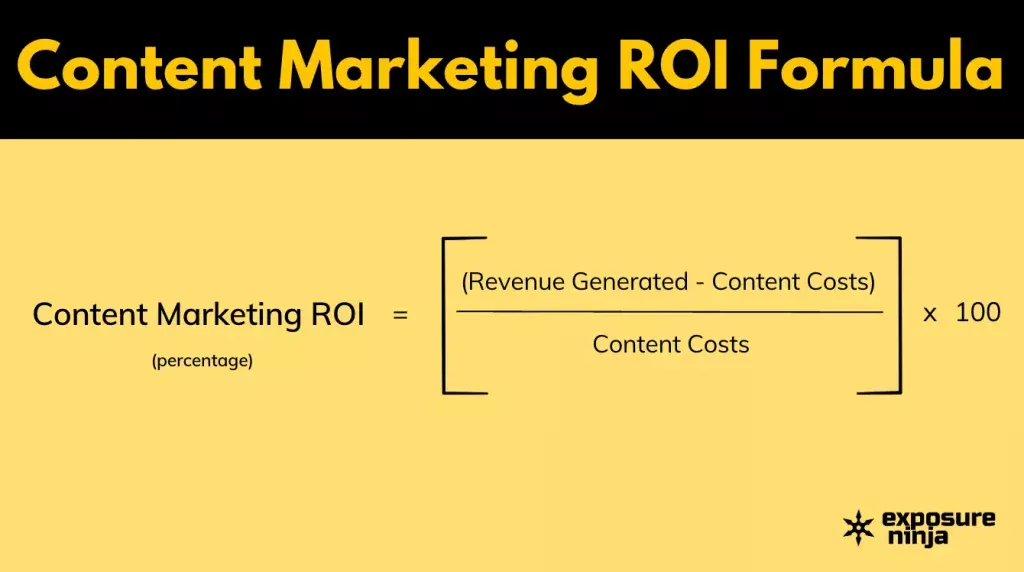
Let’s start with the basics. The formula for content marketing ROI is:
(Revenue Generated From Content — Content Costs) ÷ Content Costs × 100 = ROI (%)
Say you spend £4,000 on content creation and promotion over a quarter. That content helps generate £12,000 in revenue.
(£12,000 – £4,000) ÷ £4,000 × 100 = 200% ROI
That means for every £1 you invested, you made £2 in profit.
On paper, it looks simple. But in reality, measuring the true impact of content is far more complex, especially when the customer journey spans weeks, months, and multiple touchpoints.
Why Content Marketing ROI Can Be Complicated
Longer Cycles Make Attribution Tricky
Content marketing often plays the long game. A potential customer might first discover your brand through a blog post, subscribe to your newsletter a few weeks later, download a guide the following month, and only convert into a paying customer six months down the line. That delay and the multiple touchpoints in between makes it difficult to pinpoint which piece of content influenced the sale.
This is especially true in B2B and high-value industries where buying decisions involve multiple stakeholders, higher risks, and longer timelines. The blog, video, or LinkedIn post that started the journey may have been just as important as the final sales call, but unless you have a solid attribution model in place, it likely won’t get the credit.
Content Supports, but Doesn’t Always Convert
Not all content is designed to sell directly.
Think about early-stage blog posts or top-of-funnel videos. These may not drive immediate conversions, but they play a major role in shaping how people perceive your brand. They remove objections, answer questions, and lay the groundwork for future sales.
So, while a specific blog might not have a high conversion rate, that doesn’t mean it’s not valuable. It could be the reason a lead chooses you over a competitor months later.
ROI Doesn’t Always Show Immediately
Great content often takes time to perform. A blog post may not rank at the top of Google for weeks or even months. But once it does, it can generate consistent organic traffic and leads for years.
This delayed return can make content marketing look like a slow burn compared to paid media, where results are more immediate. But when content finally gains traction, its compounding impact often far outpaces the short-term ROI of ads.
The key is to measure content performance over a longer timeframe. Looking only at week-by-week or month-by-month results can make it seem like your content isn’t working when it just hasn’t had time to perform yet.
Don’t Forget The Hidden Wins
Content marketing delivers far more than direct conversions. While it may not always be easy to track every sale back to a specific blog post or video, the long-term value content brings to a business is undeniable.
Organic Traffic Growth
High-quality, optimised content can attract organic traffic for months or even years after publication. Unlike paid campaigns, which stop the moment the budget is paused, organic content continues to drive visibility without ongoing investment.
Evergreen blog posts and strategic content hubs are particularly effective, providing a steady stream of search-driven traffic long after the initial work is done. This compounding effect makes content one of the most cost-efficient marketing channels over time.
Lower CPA
Content that attracts and converts leads organically lowers the overall cost per acquisition (CPA). When leads find content through search engines, email, or social shares, rather than paid ads, the cost to acquire them drops significantly.
This improves overall campaign efficiency and frees up your marketing budget for other growth channels, rather than simply funding ad clicks.
Improved Brand Trust and Authority
Consistent, valuable content positions your brand as an authority in your industry. When audiences find reliable, insightful content throughout their research process, it builds trust. This trust can shorten the sales cycle and improve conversion rates.
This matters even more in B2B, where decisions take time, involve multiple stakeholders, and carry more risk. Strategic content positions your brand as the go-to in your space — not just another option. And when they trust you, these long sales cycles can get shorter and drive up conversion rates along the way.
Fuel for Other Channels
Content is not limited to blogs. A single long-form piece can be repurposed into social posts, email campaigns, ad copy, lead magnets, video scripts, and more. This multiplies the value of each content asset and supports cross-channel consistency without significantly increasing workload.
A well-structured content strategy ensures that every piece produced serves multiple purposes, maximising reach and reinforcing messaging across touchpoints.
Sales Enablement and Lead Nurturing
Content is a powerful tool for sales enablement. Case studies, comparison pages, guides, and educational content help sales teams address objections, explain solutions, and move prospects through the funnel more efficiently.
In longer sales cycles, content also supports lead nurturing. Informative email sequences, remarketing content, and resource libraries keep leads engaged over time, building trust and maintaining momentum until they’re ready to convert.
Create Revenue-Driving Content
Content ROI isn’t just about chasing clicks or pushing sales. It’s about creating smart, useful content that supports your audience every step of the way.
When calculating the ROI of your content,
- Use a clear formula to track ROI, but know it’s not the full picture.
- Factor in long-term benefits like trust, SEO, and multi-channel support.
- Understand that content ROI grows over time, so you need to invest now to benefit later.
Want help creating content that pulls its weight? Our content marketing experts can help you measure the exact ROI of your content marketing and make sure it’s driving real, measurable growth. Simply request a callback, and one of our Ninjas will walk you through where your content is winning, what needs fixing, and how to scale your results.
Looking for more insight on what not to do? Read our guide on:
FAQs
How profitable is content marketing?
When executed effectively, content marketing is highly profitable. It brings in traffic, builds trust, and generates leads at a lower cost than many paid channels — and those results compound over time.
How cost-effective is content marketing?
Content is one of the most cost-effective marketing tactics available. A single blog post can drive traffic and leads for years, all with minimal spend once it’s published.
What is a good ROI for content marketing?
A solid benchmark is a 3- 5x return, but some businesses see much more. The key is consistency — delivering useful, relevant content week after week.