What Is a Growth Loop in Marketing?

It’s the question on the lips of every business owner, CEO and more…
How are we going to grow as a company?
Admittedly, it’s a big question.
Ads? Social media? Sales? A shocking publicity stunt?
Any marketer could give you 101 different answers. But not Dalmatians (unfortunately).
Of course, “growing” your business depends on the type of business you run.
How Do I Grow My Business?
“Growing my business means I need to always be attracting new customers.”
Does that sound like you?
Sure, it’s always important to generate new interest in your brand.
But, acquiring new customers can be six to seven times more expensive than retaining existing customers.
The probability of selling your product or service to an existing customer is 14 times higher than selling to a new one.
At this point, you’re probably wondering if there’s a way to acquire new users AND retain existing customers simultaneously.
There IS a way.
You’ve got to go a bit loopy (but not literally).
Growth loops, also known as viral loops, are the answer.
But how do they work? Are they quick to set up? Is there a lot of work involved?
All that, and more, will be explained below.
But before we get into it, let’s first discuss what a growth loop is…
[us_page_block id=”9385″ remove_rows=”1″]
What Is a Growth Loop?
First off, we need to define what a growth loop is.
It’s a strategy that begins by acquiring new customers and keeping them.
How?
By providing value.
The end goal of a growth loop is to be self-sustaining. Loyal customers return and end up referring new customers to your business. Kerching!
Let’s take a look at an example.
- You’re in the business of selling Jason Bourne-themed merchandise.
- From T-shirts that read “Jesus Christ, that’s Jason Bourne!” to full-size blankets with Matt Damon’s face printed across them… you’ve got it all.
- A life-long Jason Bourne stan has just come across your site and is particularly tempted by a “Bourne 2 B Jason” snapback hat.
- Prompts or automated marketing messages on your site encourage the customer to share the content or refer a friend. This customer gets 10% off on their next purchase by referring three friends.
- The customer ends up referring this product to three friends and enjoys the benefit of 10% off the next time they visit your site.
- The cycle repeats itself — consolidating loyal customers and encouraging new ones to purchase from you.
If you’re a visual learner, it’s easier to think of it like this:
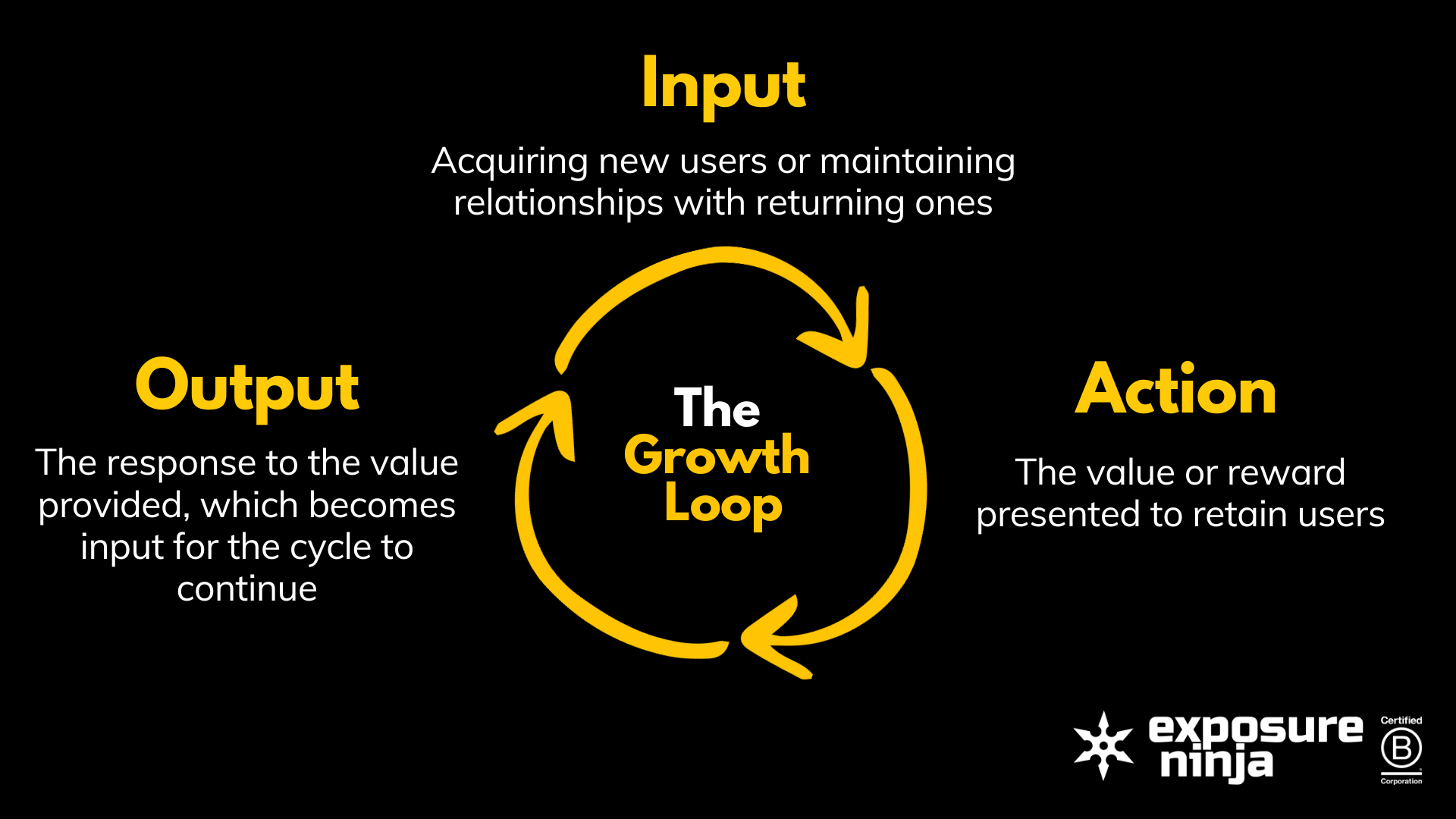
We can break this down even further.
| Input | Action | Output |
| Input is about gaining new users. This can be various things — think paid ads and organic search traffic.
The input part is the data aspect. This can tell you or your marketers which acquisition channels work best for your business.
|
Actions speak louder than words? In this case, absolutely.
The “action” part turns your input into an output. Give your customers a reward or value that encourages them to buy from you again. Free trials and discounts are a great way to do this. |
This is the result of the action and what makes the growth loop self-sufficient.
The output of the growth loop should lead to increased sales and more customers. New users mean more sales, which means more users. |
Growth Loops or Marketing Funnels?
Funnel-y enough, growth loops aren’t the only mechanism for “growing” your business.
Back in 2017, entrepreneur Dave McClure came up with a swashbuckling concept.
Pirate metrics! AARRR!
It’s similar to the AIDA marketing funnel model, with a few extra steps.
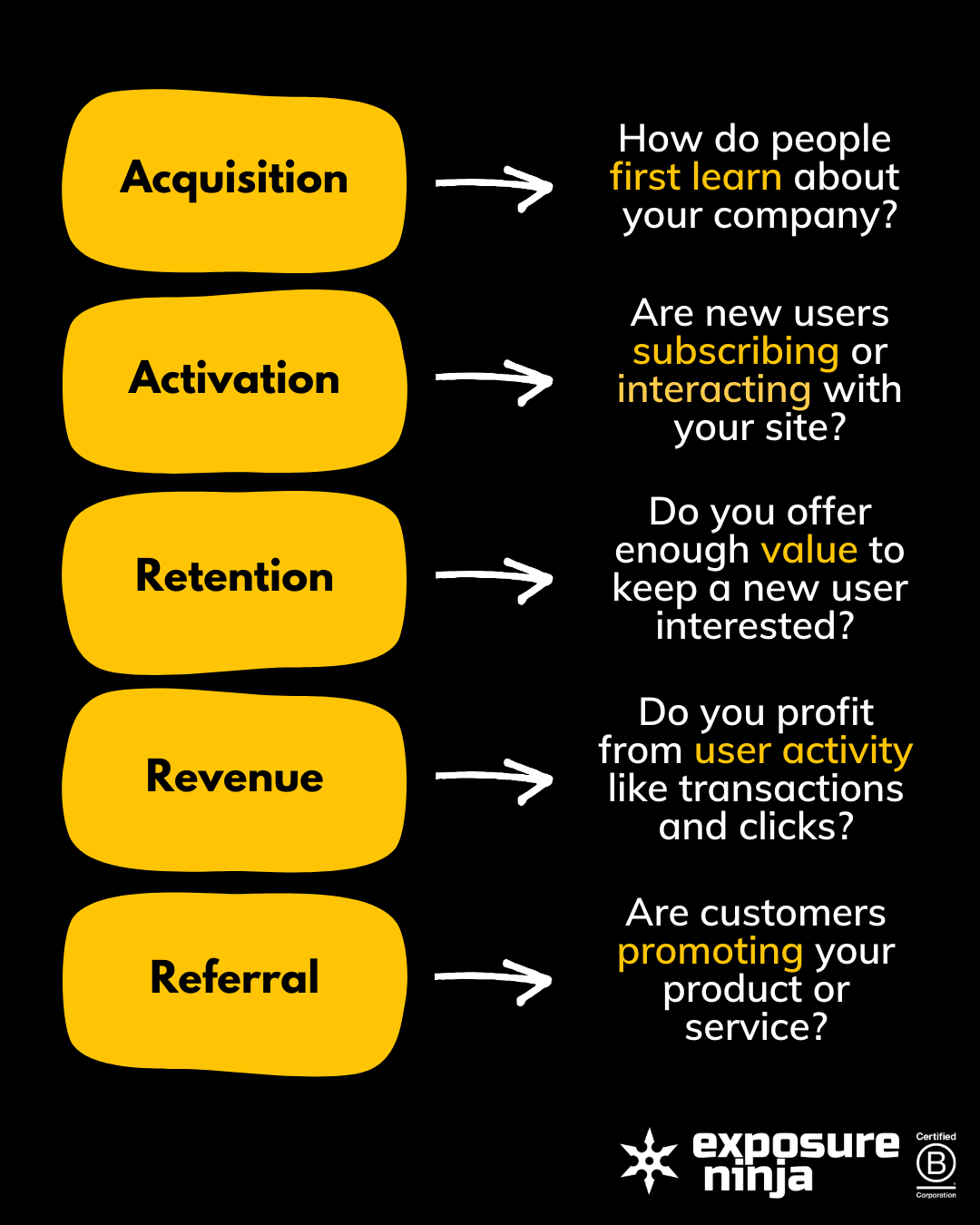
Hence the acronym “AARRR” which lends the concept its name. Avast ye!
But which one is better? Growth loops or the AARRR model?
There’s no right or wrong answer.
The AARRR model has a few pros and cons, just like everything in life.
What works for your business might not work for other companies — it’s up to you to make the best possible choice in context.
AARRR Pros
✅ Simple and straightforward to understand.
✅ The ability to visualise customer behaviours and routes to conversions.
✅ Highlights which areas your company needs to focus on for improvement (realign that marketing strategy!).
✅ Shows what your business needs to do to influence consumers at different stages.
✅ Test new ideas, marketing tactics and more to create a successful business.
AARRR Cons
❌ Funnels can create silos in your company — where employees pursue departmental goals over company objectives.
❌ Teams only focus on one aspect of the customer journey that’s relevant to them.
❌ AARRR funnels can be expensive, as you’re constantly feeding the funnel new inputs for acquisition, which costs time and money.
❌ Growth from AARRR funnels can be linear because they rely on a continual flow of inputs.
But there’s no reason why these two marketing strategies must fight it out.
You don’t need to pick a side.
It’s possible to integrate growth loops at each marketing funnel stage.
Here’s an example:
1. Let’s return to our earlier example. As one of few Jason Bourne-themed merchandise sellers, you occupy a niche market area.
2. In the AARRR model, you’re in the acquisition stage. You need new customers (and meme enthusiasts) to become aware of your truly unique offering.
3. Now it’s time to implement the growth loop aspect. A fantastic way of doing this is to create a giveaway growth loop.
4. You’ve got a bit of a surplus of Jason Bourne mugs, perfect for a giveaway. Over the coming months, you might have more surplus stock for giveaways, so plan a giveaway schedule.
5. Your giveaway needs to strongly incentivise participants to share news about it. So, to enter your Jason Bourne mugs giveaway, participants must tag five friends in the comment section of your Instagram post.
6. Offer an additional incentive. Participants who tag 10 friends in their comments receive two entries for your giveaway. You’re rewarding those who are encouraging others to enter.
7. New, tagged participants are encouraged to enter the next giveaway, creating a self-sufficient growth loop. Boom.
By combining growth loops with each stage of the funnel, you can magnify every marketing effort further.
The Greatness of Growth Loops
We’re not here to tell you what to do. You can use growth loops, AARRR/AIDA funnels or a monkey in your marketing strategy. You can even use a combination of all three.
Excepting, perhaps, the monkey. Sorry.
But growth loops do have a few perks. Here are the big three:
- Unification — All teams unite to work towards a common goal or goals.
- Sustainability — Growth loops encourage steady, continuous growth in its own ecosystem.
- Individuality — Growth loops are unique to your organisation and product, so you won’t need to worry about copycats.
Seems legit.
But what do growth or viral loops look like in practice?
Let’s take a look.
[us_page_block id=”10921″ remove_rows=”1″]
What Is a Growth Loop? The Examples
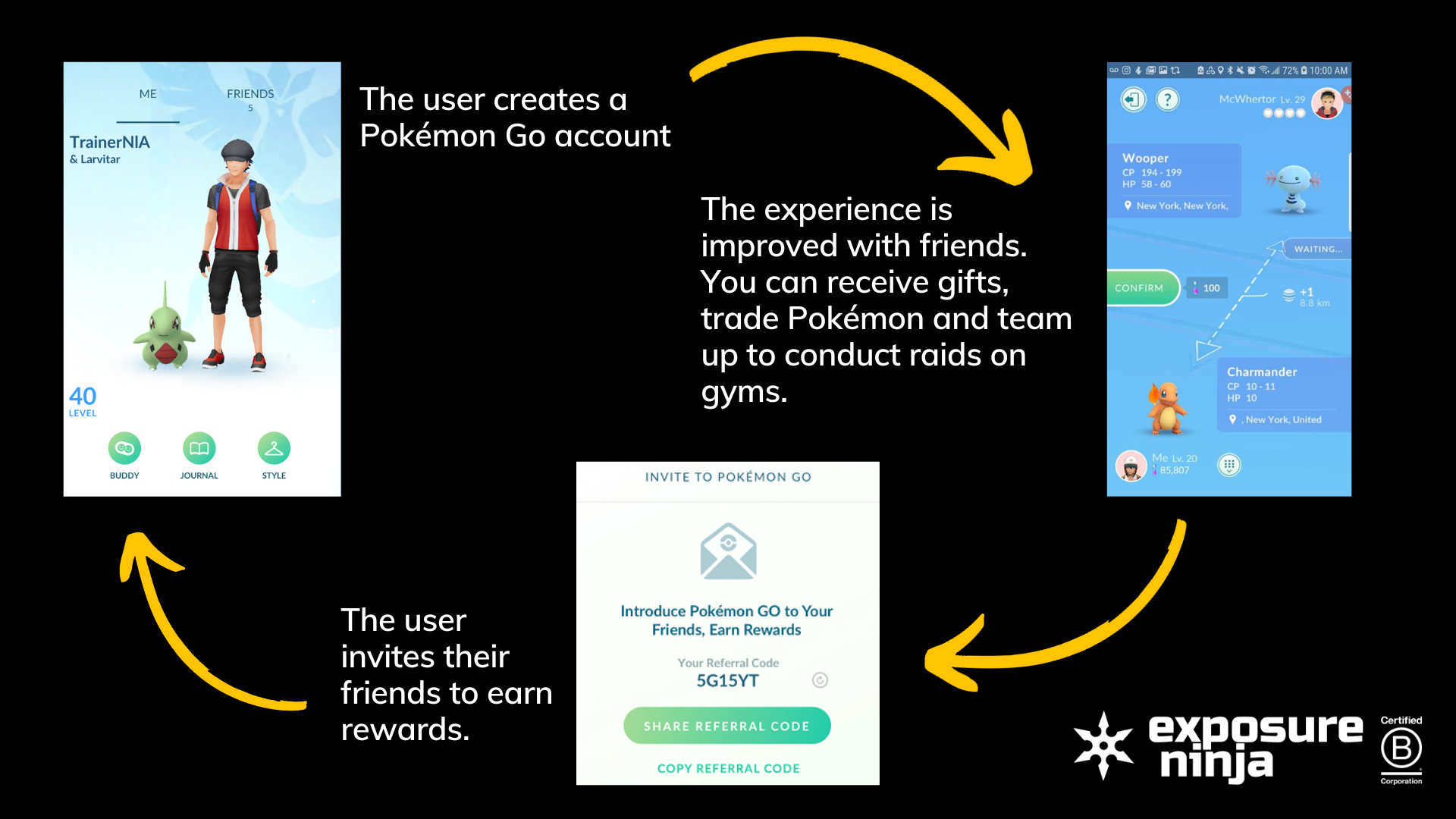
A Personal Viral Loop – Pokemon Go
Some products and services get better and better the more users participate. This creates a personal incentive for participants to invite new users.
- The user creates a Pokemon Go account
- The experience is improved with friends. You can receive gifts, trade Pokemon and team up to conduct raids on gyms
- The user invites their friends to earn rewards
- The cycle starts again.
A Financial Incentive
A discount — what’s not to love? Incentivise new users by providing a financial benefit.
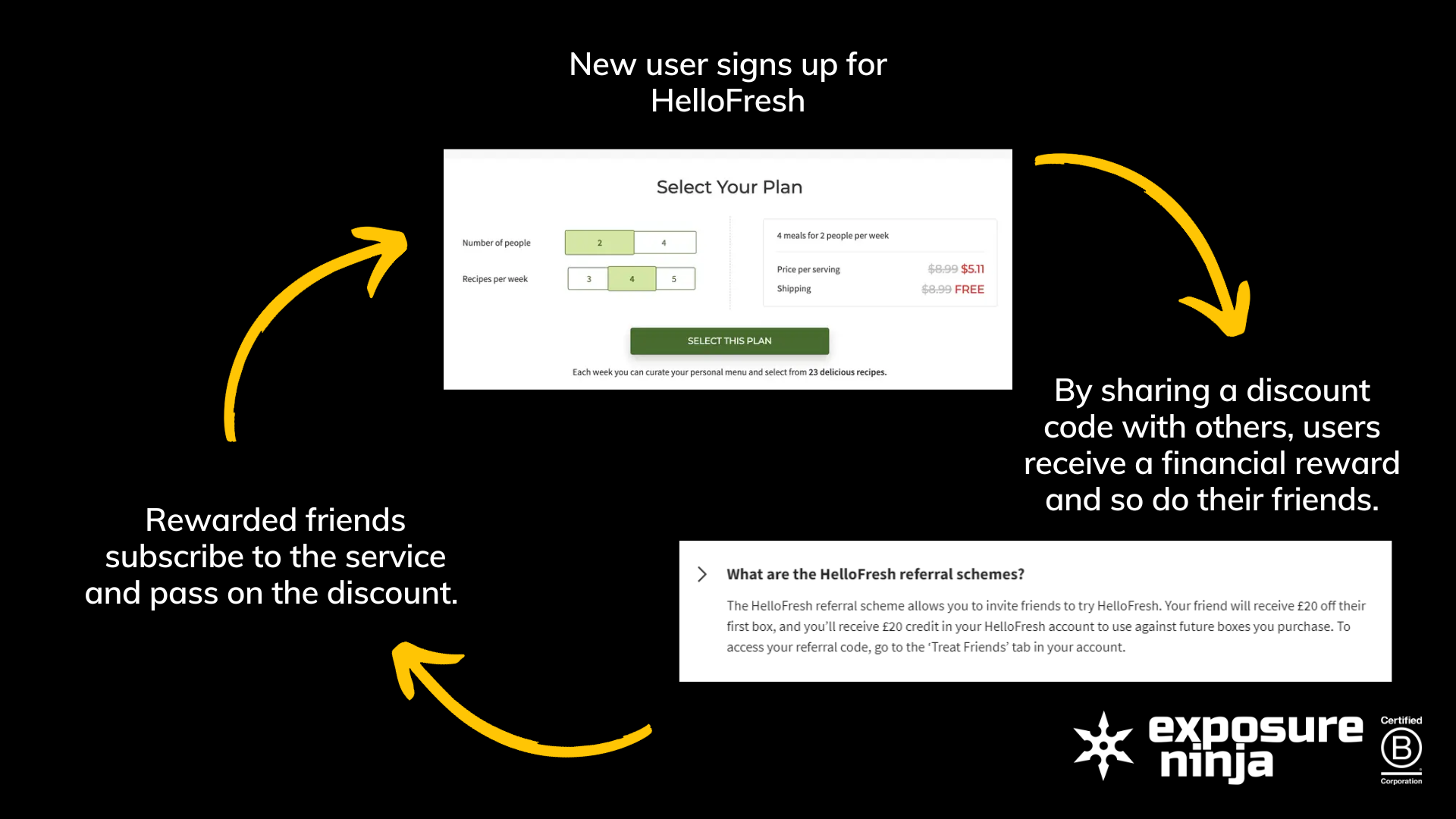
- A new user signs up for Hello Fresh meal kits
- By sharing a discount code with others, users receive a financial reward and so do their friends
- Rewarded friends subscribe to the service
- The cycle starts again.
The Social Viral Loop
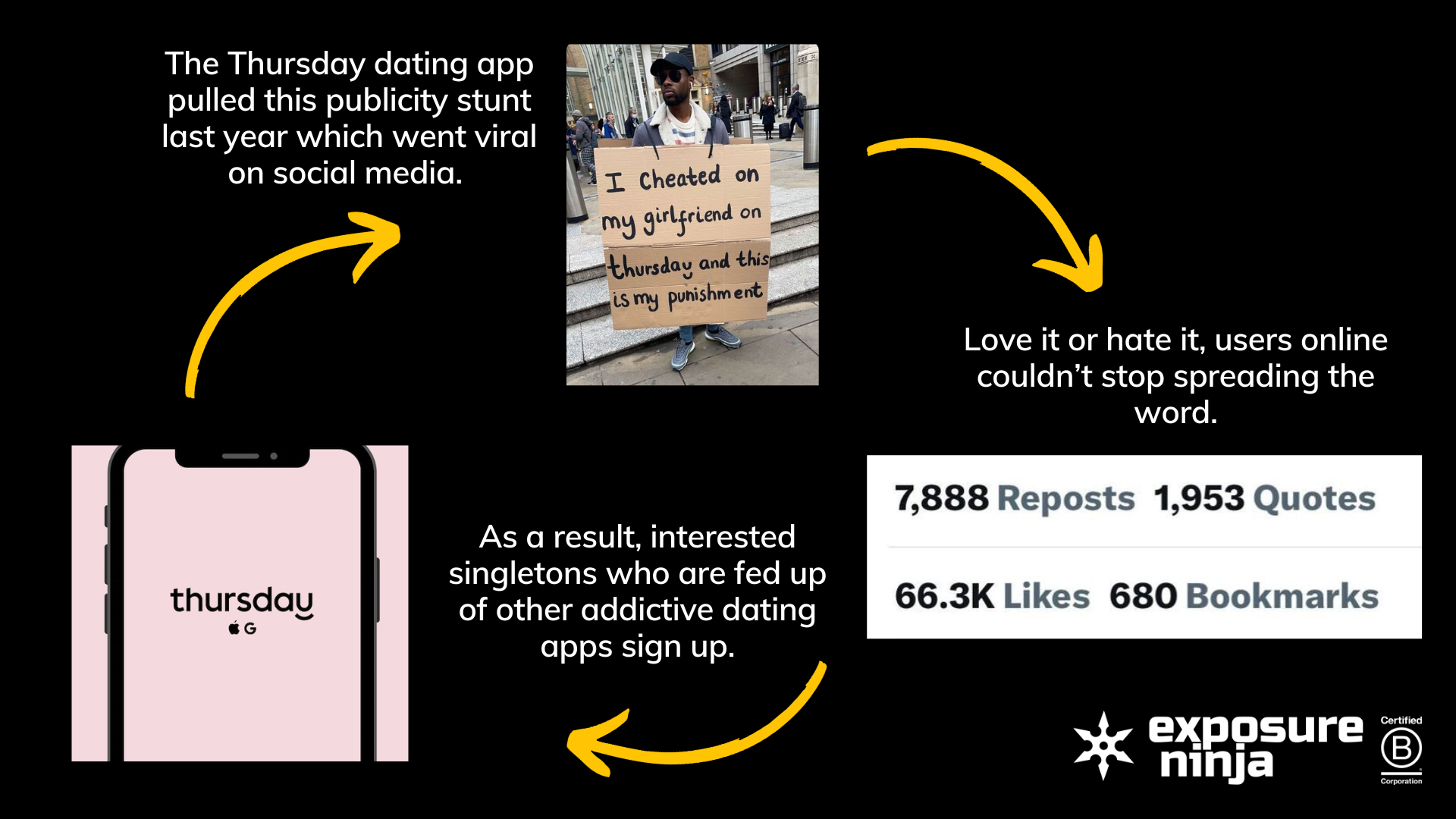
- The dating app Thursday pulled a publicity stunt last year where a person wore a cardboard sign saying “I cheated on my girlfriend on Thursday and this is my punishment”
- Love it or hate it, users online couldn’t stop spreading the word, resulting in 7,888 reposts, over 66,000 likes and more on X (formerly known as Twitter)
- As a result, interested singletons who are fed up with other addictive dating apps sign up
What came first, the chicken or the egg?
Most people think that initially, you need to build a product or a service before you market it.
The product or service doesn’t precede marketing. It is marketing.
Thinking in growth loops allows you to build your marketing into your product or service.
What to Read Next
- Find out how we reduced our CPA (cost per acquisition) for an established SaaS business in this case study.
- New to marketing? Not sure where to begin with your marketing strategy? Check out our blog post or YouTube video on creating a marketing strategy for startups.